
B2B prospecting uses two data layers that teams often confuse. Company data vs contact data serve different purposes—account-level firmographics drive ICP targeting and segmentation; person-level contact details drive outreach and relationship building. Mixing them up leads to bad imports, wrong routing, and incomplete records.
This guide explains each data type, when to use which, and how AI workflows produce both layers together.
Related: what is prospect data, AI company research, AI contact discovery, and company fit score explained.
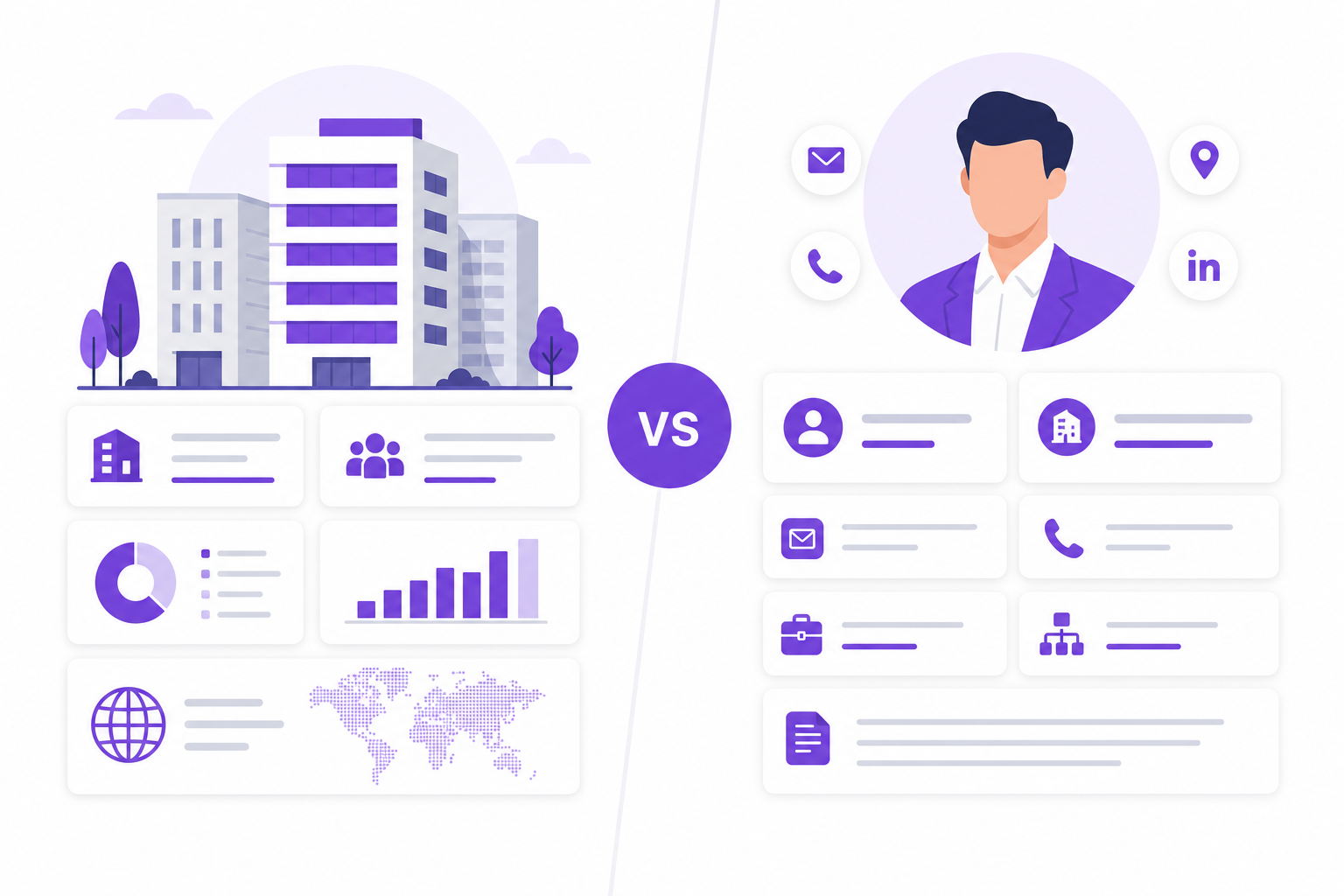
Company Data: Account-Level Intelligence
Company data describes the organization:
- Legal name, DBA, domain, website
- Industry, sub-industry, SIC/NAICS codes
- Employee count, annual revenue range
- Headquarters, operating regions
- Parent company, subsidiaries, ownership
- Technographics, funding, growth signals
Used for: ICP filtering, territory assignment, account-based targeting, company fit scoring.
Contact Data: Person-Level Intelligence
Contact data describes the individual:
- Full name, job title, department, seniority
- Verified email, phone, LinkedIn URL
- Employment verification status
- Decision-maker vs. influencer classification
- Engagement history (if in CRM)
Used for: Email outreach, cold calls, meeting scheduling, relationship tracking.
Side-by-Side Comparison
| Dimension | Company Data | Contact Data |
|---|---|---|
| Unit of record | Account / organization | Person / individual |
| Primary use | ICP targeting, ABM | Outreach, relationship |
| Key score | Company fit / ICP score | Role relevance, verification |
| Decay rate | Slower (annual refresh) | Faster (quarterly verify) |
| CRM object | Account / Company | Contact / Lead |
Why You Need Both
Company data without contacts gives you targets but no one to email. Contact data without company context gives you names without ICP fit assessment. High-quality prospect records link both layers—with company fit score informing which contacts to prioritize.
How Adsaga.ai Delivers Both Layers
- Create configuration (
/workflow/config/create) — company-level ICP criteria - Run workflow (
/workflow/workflows) — discover companies AND decision-makers - View tiered leads — company ICP score + contact verification + Receptivity score
- Export — linked company and contact records with scoring
Frequently Asked Questions
What is the difference between company data and contact data?
Company data is account-level firmographics (industry, size, revenue). Contact data is person-level details (name, email, title). Both are needed for effective B2B prospecting.
Which matters more for outbound?
Both—company data determines if you should outreach; contact data determines who you reach. ICP fit scoring uses company data; verification uses contact data.
Should company and contact data be in one record?
In CRM, link contacts to accounts. In prospect exports, include both layers with company fit score attached to each contact record.
How does AI handle both data types?
AI workflows discover ICP-fit companies first, then map and verify decision-maker contacts—producing linked company + contact records with scoring.
How does Adsaga.ai combine company and contact data?
Every tier-rated lead includes company firmographics, ICP score, and verified contact details—both layers in one export-ready record.
Final Thoughts
Company data vs contact data is not an either/or choice. Link both with ICP scoring—and prospect records become actionable pipeline, not disconnected fields.
Try Adsaga.ai — company and contact data, scored together.