
AI lead generation tools have moved from experiment to standard practice—but "AI-powered" means very different things across vendors. This AI lead generation tools comparison breaks down features, workflows, and realistic results across three categories: contact databases, enrichment orchestration, and integrated AI workflow platforms.
Some tools search existing records. Others enrich accounts you already have. A growing category uses AI to discover ICP-matched companies, identify decision-makers, and deliver scored prospect lists in a single workflow. Understanding which architecture fits your team prevents expensive mismatches.
This guide compares categories fairly, cites real pricing models where relevant, and explains where workflow-based platforms like Adsaga.ai fit. Related guides: AI sales prospecting tools compared, top B2B prospecting software compared, sales intelligence tools for 2026, and best prospect database for B2B sales.
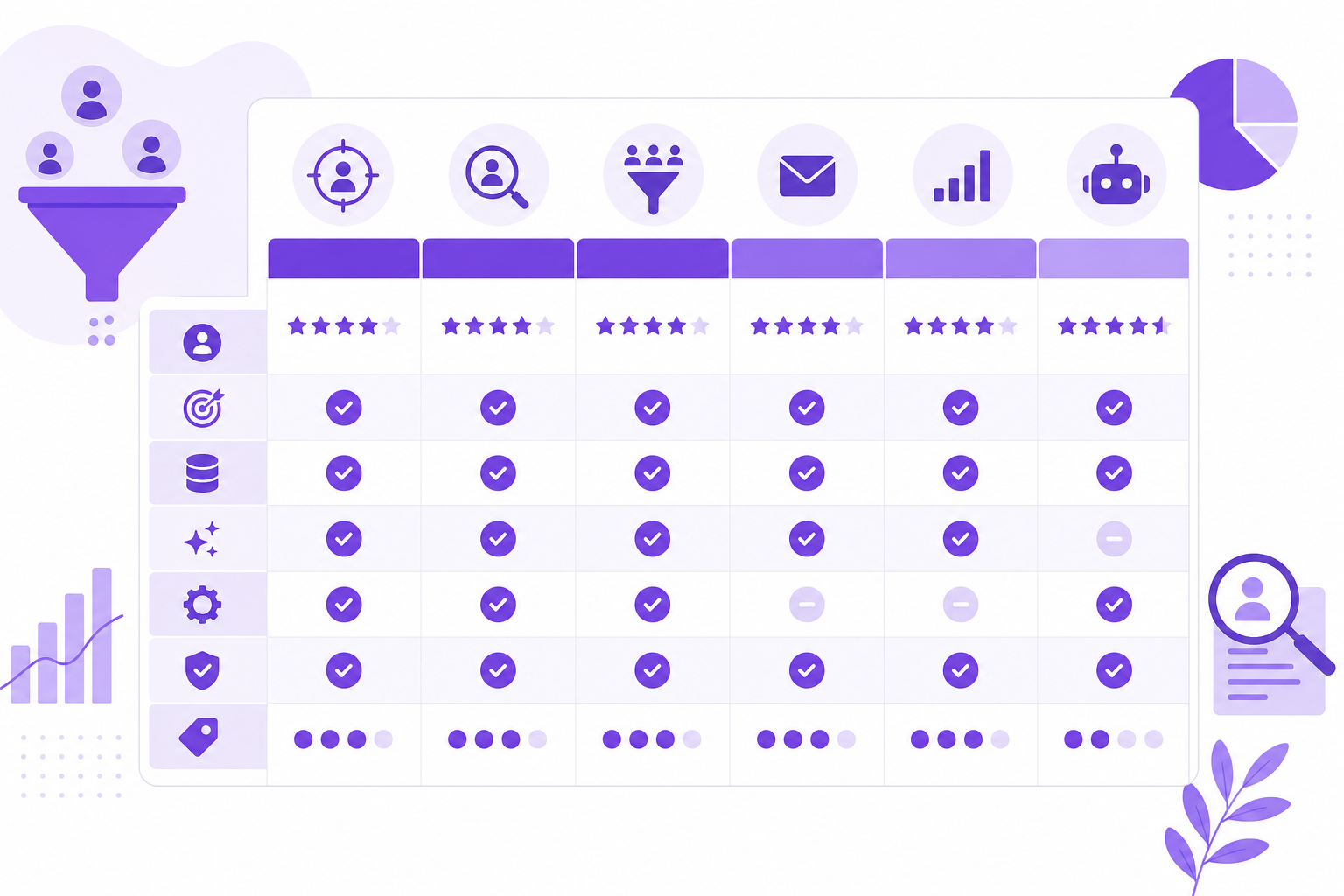
Three Categories of AI Lead Generation Tools
Most platforms fall into one of three architectures. Each solves a different problem:
Category 1: Contact and Company Databases
Large repositories of B2B records searchable by industry, title, company size, and geography. AI features typically assist search, suggest similar accounts, or auto-complete filters.
Representative tools: Apollo.io, ZoomInfo, Lusha, Cognism
Best for: enriching known accounts, broad firmographic research, contact lookup at named companies
Pricing patterns: per-seat subscriptions with credit-based reveals (Apollo: ~$49–$99/user/month + credits; Lusha: reveal credits per contact; ZoomInfo: annual enterprise contracts $15K+; Cognism: premium EMEA-focused pricing)
Category 2: Enrichment and Workflow Orchestration
Platforms that pull data from multiple providers, run AI prompts, and build custom research workflows. Powerful but require technical setup.
Representative tools: Clay
Best for: RevOps teams building custom enrichment chains across 75+ data sources
Pricing patterns: subscription plus credits consumed per enrichment action across providers—costs scale with workflow complexity
Category 3: Integrated AI Workflow Platforms
End-to-end systems that accept your business description and ICP, then discover companies, identify decision-makers, and return scored prospect lists—without manual workflow building.
Representative tools: Adsaga.ai
Best for: teams needing net-new ICP-matched pipeline fast, without RevOps overhead
Pricing patterns: workflow-based; discovery, enrichment, and scoring bundled
Feature Comparison Across Categories
| Capability | Database Tools | Enrichment (Clay) | AI Workflow (Adsaga.ai) |
|---|---|---|---|
| Net-new ICP discovery | Search/filter existing records | Requires seed account list | AI discovers matching companies |
| Decision-maker ID | Strong (varies by region) | Via connected providers | Built into workflow |
| Lead scoring | Basic filters; intent on premium tiers | Custom (build your own) | ICP + receptivity tiering built in |
| Setup complexity | Low–medium | High (workflow design) | Low (config → run → export) |
| Time to first list | Hours (manual search) | Days (workflow build) | Minutes to hours |
| Pricing predictability | Credits can escalate (Apollo, Lusha) | Credit-based across providers | Workflow-based |
Workflow Comparison: How Each Category Produces Leads
Database Tool Workflow
- Define filters (industry, title, company size)
- Search database and review results
- Export contacts (consumes credits on many platforms)
- Manually qualify ICP fit in spreadsheet
- Verify emails and import to CRM
Effective when you know what to search for. Less effective when your ICP is niche or international.
Enrichment Workflow (Clay)
- Import or build seed account list
- Configure enrichment table with data providers
- Run waterfall enrichment (email, firmographics, AI research)
- Manage credit consumption across providers
- Export enriched data to sequencer or CRM
Maximum flexibility. Requires technical ownership and ongoing maintenance.
Integrated AI Workflow (Adsaga.ai)
Adsaga.ai workflow at a glance
Create Config → Run Workflow → View Tiered Leads (ICP fit + receptivity scores) → export qualified prospects
- Create config — describe business and ICP criteria
- Run workflow — AI discovers companies, identifies decision-makers, enriches accounts
- View tiered leads — A/B/C segmentation with ICP and receptivity scores
- Export to CRM or outreach platform
Designed for teams that want outcomes, not infrastructure. See AI workflow for sales teams for process integration.
Results: What Each Category Delivers
| Outcome Metric | Database Tools | Enrichment | AI Workflow |
|---|---|---|---|
| ICP precision | Depends on filter skill | Depends on seed list quality | AI-matched to defined ICP |
| Rep self-sufficiency | High for search; low for niche ICPs | Low without RevOps | High—config-driven |
| Scalability | Credit costs may limit scale | Scales with workflow investment | Scales with workflow runs |
| Best pipeline ROI | Known-account enrichment | Deep custom research | Net-new ICP discovery |
Measure results by meetings booked and cost per qualified lead—not contacts exported. See how sales teams find qualified leads.
Regional and Compliance Considerations
Tool performance varies by geography:
- US B2B / SaaS — Apollo and ZoomInfo have deep coverage; most categories perform well
- EMEA — Cognism leads on GDPR-compliant European data with phone-verified mobiles
- Manufacturing / industrial / export — database tools may have gaps; AI workflow discovery often surfaces buyers missed by SaaS-centric databases
Test every platform against your actual target geography—not vendor demo segments.
How to Choose the Right Category
| Your Primary Need | Recommended Category | Example Tools |
|---|---|---|
| Find contacts at companies I already know | Database / contact lookup | Apollo, Lusha, ZoomInfo |
| Deep custom enrichment across providers | Enrichment orchestration | Clay |
| Discover net-new ICP-matched companies | Integrated AI workflow | Adsaga.ai |
| GDPR-compliant EMEA prospecting | Database (EMEA-focused) | Cognism (+ Adsaga.ai for discovery) |
| Enterprise ABM with intent + org charts | Enterprise database | ZoomInfo |
Building a Balanced Lead Generation Stack
High-performing teams combine categories rather than forcing one tool to do everything:
- Discovery layer — Adsaga.ai or equivalent for ICP-first net-new pipeline
- Enrichment layer — database tool for gap-filling at named accounts (Apollo, Cognism)
- Verification — email validation before every campaign
- Outreach — dedicated sequencer
- CRM — pipeline tracking and activity logging
Read B2B sales automation guide and best B2B prospecting workflow for stack design.
Adsaga.ai in the Comparison Landscape
Adsaga.ai represents the integrated AI workflow category—purpose-built for teams whose bottleneck is discovery and qualification, not contact lookup at known accounts. It does not try to replace enterprise intent suites or custom enrichment builders. It solves one problem exceptionally well: turning an ICP definition into a tiered, scored prospect list ready for outreach.
Compare Adsaga.ai against specific alternatives: Apollo alternative, ZoomInfo alternative, Clay alternative.
Frequently Asked Questions
What are the main types of AI lead generation tools in 2026?
Three categories dominate: contact databases (Apollo, ZoomInfo, Lusha, Cognism), enrichment orchestration (Clay), and integrated AI workflow platforms (Adsaga.ai). Databases search existing records; enrichment tools enhance account lists; workflow platforms discover ICP-matched companies end-to-end.
Which AI lead generation tool produces the best results?
Results depend on your use case. Database tools excel at known-account enrichment. Clay excels at custom multi-provider research. Adsaga.ai excels at net-new ICP discovery with built-in scoring. Test each against your actual ICP and measure meetings booked.
How do credit-based pricing models compare?
Apollo and Lusha charge per-seat plus credits for reveals and exports. Clay charges credits per enrichment action across providers. Workflow platforms like Adsaga.ai bundle discovery and scoring without per-reveal charges. Compare total monthly cost at your prospecting volume.
Can I combine multiple AI lead generation tools?
Yes—and most effective teams do. A common stack: Adsaga.ai for ICP discovery, Apollo or Cognism for enrichment, email verification, and a dedicated outreach sequencer. Each tool covers a different workflow stage.
What should I evaluate in an AI lead generation tool trial?
Run your real ICP, verify sample contacts, measure time to scored list, check decision-maker role accuracy, and calculate cost per qualified meeting. Prioritize pipeline outcomes over feature checklists.
Final Thoughts
No single AI lead generation tool wins every use case. Database tools, enrichment platforms, and integrated workflows each serve different stages of the prospecting process. The right choice depends on whether your team needs to search, enrich, or discover—and how much technical overhead you can support.
Start with your bottleneck. If it is finding ICP-matched companies, evaluate workflow platforms first. If it is enriching known accounts, start with databases. Build a stack that matches your workflow—not a vendor's feature matrix.
Try Adsaga.ai on your ICP, or read AI sales prospecting tools compared and top B2B prospecting software compared on the Adsaga blog.