
Every B2B sales team needs a reliable source of company and contact data—but not all prospect databases are built equal. The best prospect database for B2B sales delivers ICP-matched companies, verified decision-maker contacts, fresh data, and seamless CRM integration—not just millions of outdated email addresses. Choosing the wrong database wastes budget, damages sender reputation, and fills your pipeline with unqualified noise.
In 2026, prospect databases range from legacy B2B contact repositories to AI-powered discovery platforms that proactively find companies matching your Ideal Customer Profile. This guide compares database types, explains what B2B sales teams should evaluate, and shows how to combine databases with automation and verification for maximum pipeline quality.
Related reading: sales intelligence tools for 2026, AI sales prospecting tools compared, and lead research automation.
What Is a Prospect Database?
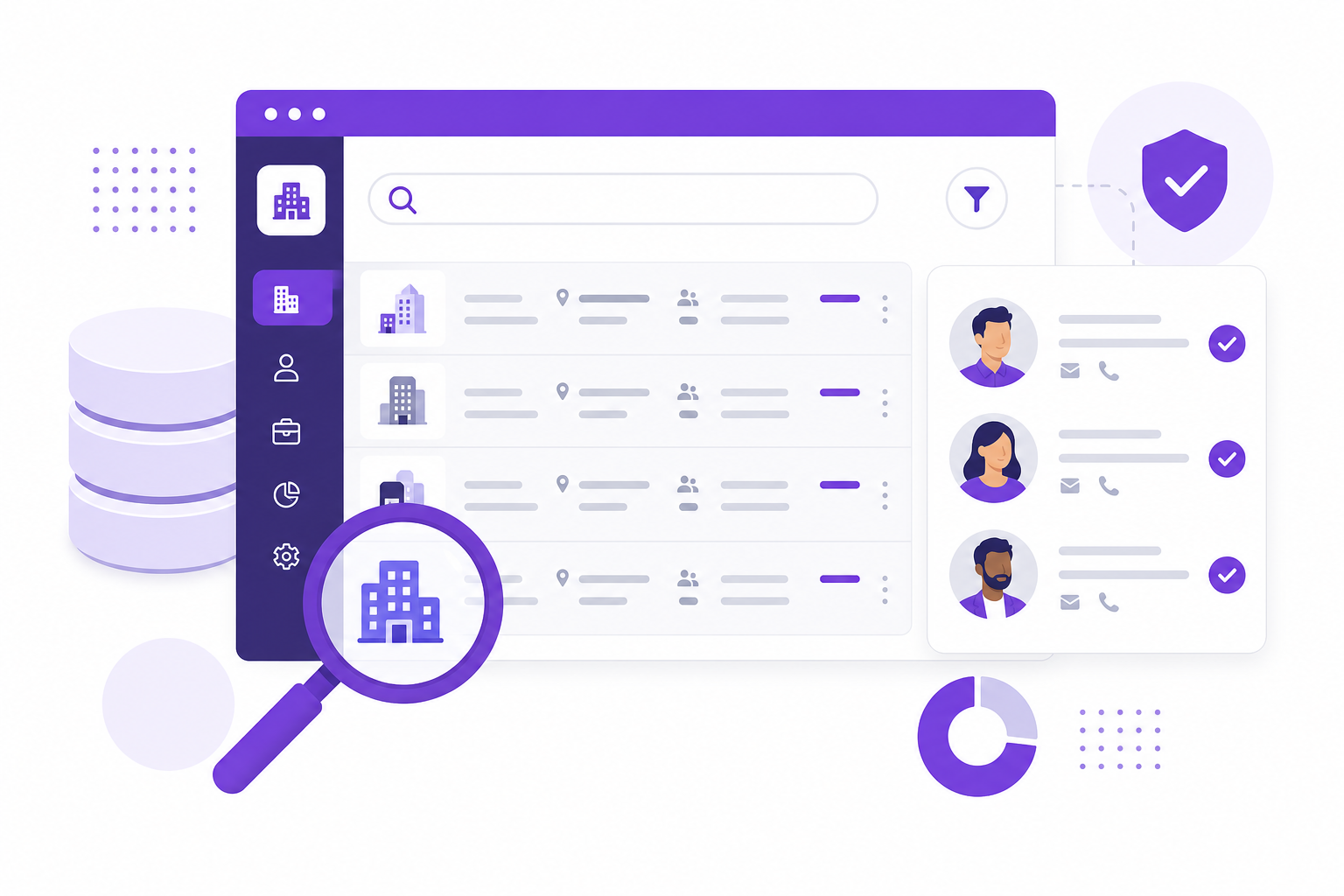
A prospect database is a collection of B2B company and contact records that sales teams use to identify, research, and reach potential customers. Records typically include:
- Company name, website, and industry classification
- Revenue, employee count, and headquarters location
- Contact names, job titles, email addresses, and phone numbers
- LinkedIn profiles and social presence
- Technographic data (software and tools used)
- Buying signals, news triggers, and intent indicators (on advanced platforms)
Databases can be static—purchased lists exported as CSV files—or dynamic platforms with search, filter, enrichment, and continuous updates.
Types of B2B Prospect Databases
1. General B2B Contact Databases
Large repositories with millions of company and contact records across industries. Strong for broad search and enrichment but often lack ICP-specific discovery and import-relevance signals.
2. AI-Powered Discovery Platforms
These do not just store data—they actively find companies matching your ICP and identify decision-makers. Fastest-growing category for B2B sales in 2026. See AI sales prospecting tools compared.
3. Industry-Specific Databases
Focused on particular sectors: healthcare, manufacturing, construction, legal, or export trade. Narrower coverage but deeper relevance for niche buyers.
4. Intent and Signal Databases
Track which accounts are actively researching solutions in your category. Best paired with contact databases for timing-aware outreach.
5. Purchased Static Lists
Pre-compiled contact lists sold by industry or geography. Lowest cost but highest decay rate—often 20–40% of emails bounce within months. Generally the weakest option for quality-focused teams.
What B2B Sales Teams Need from a Prospect Database
Evaluate databases against these requirements—not vanity metrics like total record count:
- ICP matching — filter by industry, size, revenue, geography, and buyer relevance
- Decision-maker depth — role-specific contacts, not generic info@ addresses
- Data freshness — regularly updated emails and job titles
- Verification — built-in or easy-to-integrate email validation
- Geographic coverage — your target markets, not just US tech companies
- CRM export — one-click integration with Salesforce, HubSpot, or your stack
- Lead scoring — prioritize highest-fit prospects automatically
- Compliance — GDPR, CAN-SPAM, and data sourcing transparency
A database with 500 million contacts is useless if none match your ICP or pass verification.
Best Prospect Databases Compared: Evaluation Framework
| Database Type | Best For | Strengths | Limitations |
|---|---|---|---|
| AI discovery platforms | Building ICP-matched lists fast | Proactive discovery, scoring, decision-makers | Requires ICP definition upfront |
| General B2B databases | Enrichment and broad research | Large coverage, CRM integrations | Weak ICP filtering, stale international data |
| Industry-specific databases | Niche vertical prospecting | Deep sector relevance | Limited cross-industry coverage |
| Intent databases | Timing-aware prioritization | Buying signal detection | Needs contact data layer |
| Static purchased lists | Budget-constrained one-off campaigns | Low upfront cost | High bounce rates, no freshness |
Most high-performing teams use an AI discovery platform as the primary source, supplemented by a general database for enrichment where needed.
AI-Powered vs Traditional Prospect Databases
The fundamental difference is proactive vs reactive data access:
- Traditional databases — you search and filter existing records; quality depends on what was already collected
- AI discovery platforms — you define your ICP and the system finds matching companies and contacts you may never have found manually
Traditional databases excel at enriching known company names. AI platforms excel at net-new prospect discovery. Compare in depth: AI prospecting vs manual prospecting.
How to Evaluate a Prospect Database Before Buying
- Define your ICP first — industry, size, geography, buyer type, disqualifiers
- Request a sample export — 50–100 records in your actual target segment
- Verify sample contacts — check email deliverability and role accuracy manually
- Test decision-maker coverage — are procurement, operations, and executive roles represented?
- Check data freshness — when were records last updated?
- Test CRM integration — export a list and confirm field mapping works
- Compare cost per qualified lead — not cost per contact exported
Never buy based on a vendor demo using cherry-picked data. Test with your ICP, your markets, your buyer types. Follow lead verification best practices on every sample.
Prospect Database + Verification Workflow
Even the best database requires a verification step before outreach:
- Export or generate prospect list from database
- Run email verification (deliverability check)
- Spot-check role accuracy on LinkedIn or company websites
- Remove duplicates and companies on your do-not-contact list
- Score and segment by ICP fit (A/B/C tiers)
- Import verified, scored list into CRM
- Assign to reps or launch outreach sequences
Skipping verification is the most common reason prospect database investments fail to produce ROI. Automate this workflow with lead research automation.
Prospect Databases by Sales Team Size
Startups and Small Teams (1–5 reps)
One AI discovery platform replaces the need for multiple database subscriptions. Focus on ICP match quality over record volume. Budget: one platform at $100–$300 per user per month typically suffices.
Growing Teams (5–20 reps)
Standardize on a primary database for discovery plus optional enrichment layer. Implement verification workflows and territory-based list assignment. Use lead research checklist for quality control.
Enterprise Teams (20+ reps)
Layer AI discovery, general enrichment, intent data, and data governance policies. RevOps owns database selection, CRM hygiene, and compliance. Multiple databases may coexist for different regions or business units.
Common Prospect Database Mistakes
- Choosing by database size instead of ICP relevance
- Buying static lists without verification
- Using domestic-focused databases for international prospecting
- Exporting thousands of contacts without scoring or segmentation
- Ignoring data compliance requirements (GDPR, opt-out management)
- Not integrating database exports into CRM workflows
- Renewing subscriptions without measuring conversion metrics
Each mistake turns a database investment into an expensive email bounce generator.
Prospect Database vs Sales Intelligence Platform
These terms overlap significantly in 2026. Traditional distinction:
- Prospect database — primarily stores and delivers contact/company records
- Sales intelligence platform — adds intent signals, news triggers, scoring, and account insights
Leading AI platforms blur this line by combining discovery, enrichment, scoring, and intelligence in one tool. Evaluate based on your primary need: building new lists (database/discovery) or understanding existing accounts (intelligence). Read sales intelligence tools for 2026 for the full picture.
Building a Data-Driven Prospecting Stack
Combine your prospect database with complementary tools:
- Discovery — AI platform or database for ICP-matched list building
- Verification — email validation before every campaign
- Enrichment — fill firmographic gaps on priority accounts
- Outreach — email sequencer and LinkedIn tools for execution
- CRM — pipeline management and activity tracking
The database is the foundation. Outreach and CRM tools are only as effective as the data feeding them. See the B2B sales automation guide for end-to-end workflow design.
Decision-Maker Data: The Critical Differentiator
Company records without the right contacts are incomplete. The best prospect databases identify decision-makers by role:
- VP Sales, CRO, Head of Revenue
- Procurement Manager, Purchasing Director
- Operations Manager, Plant Manager
- IT Director, CTO (for technology purchases)
- CFO, Finance Director (for budget authority)
- CEO, Founder (for SMB targets)
Generic company emails and outdated titles produce near-zero reply rates. Prioritize databases with role-specific, verified decision-maker coverage. Learn how AI improves this process: how AI finds B2B decision-makers.
Measuring Prospect Database ROI
Track these metrics to justify database spend:
- Contact verification rate — percentage passing email validation
- ICP match rate — percentage of exported contacts that fit your profile
- Reply rate — outreach responses from database-sourced lists
- Meetings per 100 contacts — ultimate efficiency metric
- Cost per qualified lead — database cost divided by verified, ICP-matched contacts that convert
- Pipeline value generated — revenue attributed to database-sourced opportunities
If cost per qualified lead exceeds your customer acquisition budget, the database is too expensive—regardless of how many contacts it contains.
Frequently Asked Questions
What is the best prospect database for B2B sales?
The best prospect database delivers ICP-matched companies with verified decision-maker contacts, fresh data, and CRM integration. AI-powered discovery platforms outperform traditional static databases for most B2B teams because they proactively find relevant prospects rather than requiring manual search through millions of records.
Are purchased B2B contact lists worth it?
Generally no for quality-focused teams. Static lists decay quickly—20–40% of emails may bounce within months. Role changes and company turnover make purchased lists unreliable. AI discovery platforms with verification produce better ROI despite higher per-contact cost.
How do I verify prospect database contacts?
Run email deliverability checks, cross-reference titles on LinkedIn and company websites, remove duplicates, and spot-check a sample before full campaign launch. Never outreach unverified contacts. See our B2B lead verification guide.
What is the difference between a prospect database and a CRM?
A prospect database provides company and contact data for discovery and enrichment. A CRM manages relationships, tracks deals, and logs sales activities. Feed your CRM with qualified prospects from your database— they serve different but complementary roles.
How often should prospect database data be updated?
Contact data should be verified before every campaign. Platform-level updates should occur continuously or at minimum quarterly. Job titles and emails change frequently—data older than six months without verification is a liability for outreach campaigns.
How Adsaga.ai Powers Prospect Discovery
Adsaga.ai goes beyond traditional prospect databases—it uses AI to discover ICP-matched companies, identify verified decision-makers, and deliver scored lists ready for outreach.
With Adsaga.ai, B2B sales teams can:
- Discover companies matching your ICP—not just search existing records
- Access verified procurement, operations, and executive contacts
- Build scored prospect lists prioritized by fit and relevance
- Cover multiple industries, geographies, and buyer types
- Export directly to CRM and outreach workflows
- Replace static purchased lists with continuously fresh data
Evaluate Adsaga.ai against your current database with a real ICP test. Try Adsaga.ai and compare contact quality on your target market.
Final Thoughts
The best prospect database for B2B sales in 2026 is not the one with the most contacts—it is the one that delivers verified, ICP-matched decision-makers your reps can actually reach. AI discovery platforms have redefined what a prospect database can do, shifting from passive record storage to active buyer identification.
Define your ICP, test databases with real samples, verify every contact, and measure meetings booked—not exports downloaded. The right data foundation transforms outreach from spray-and-pray into targeted conversations with buyers who fit your ideal profile.
Ready to upgrade your prospect data? Get started with Adsaga.ai or browse more B2B sales guides on the Adsaga blog.