
Your Ideal Customer Profile (ICP) is the single most important document in B2B sales. It tells your team exactly who to target, who to ignore, and why. Without a clear ICP, prospecting becomes random, qualification becomes subjective, and pipeline fills with leads that never close. This guide shows you how to build an ideal customer profile for B2B sales—from data analysis to validation, documentation, and ongoing refinement.
Whether you are launching outbound for the first time, rebuilding targeting after missed quotas, or aligning marketing and sales around shared criteria, a well-built ICP is the foundation everything else depends on.
You will learn how to analyze your best customers, define firmographic and behavioral criteria, document disqualifiers, validate your ICP with data, and keep it current as your business evolves.
For related context, see how to identify your ideal customer profile, AI ICP Generator explained, and ICP-based B2B lead generation.
What Is an Ideal Customer Profile (ICP)?
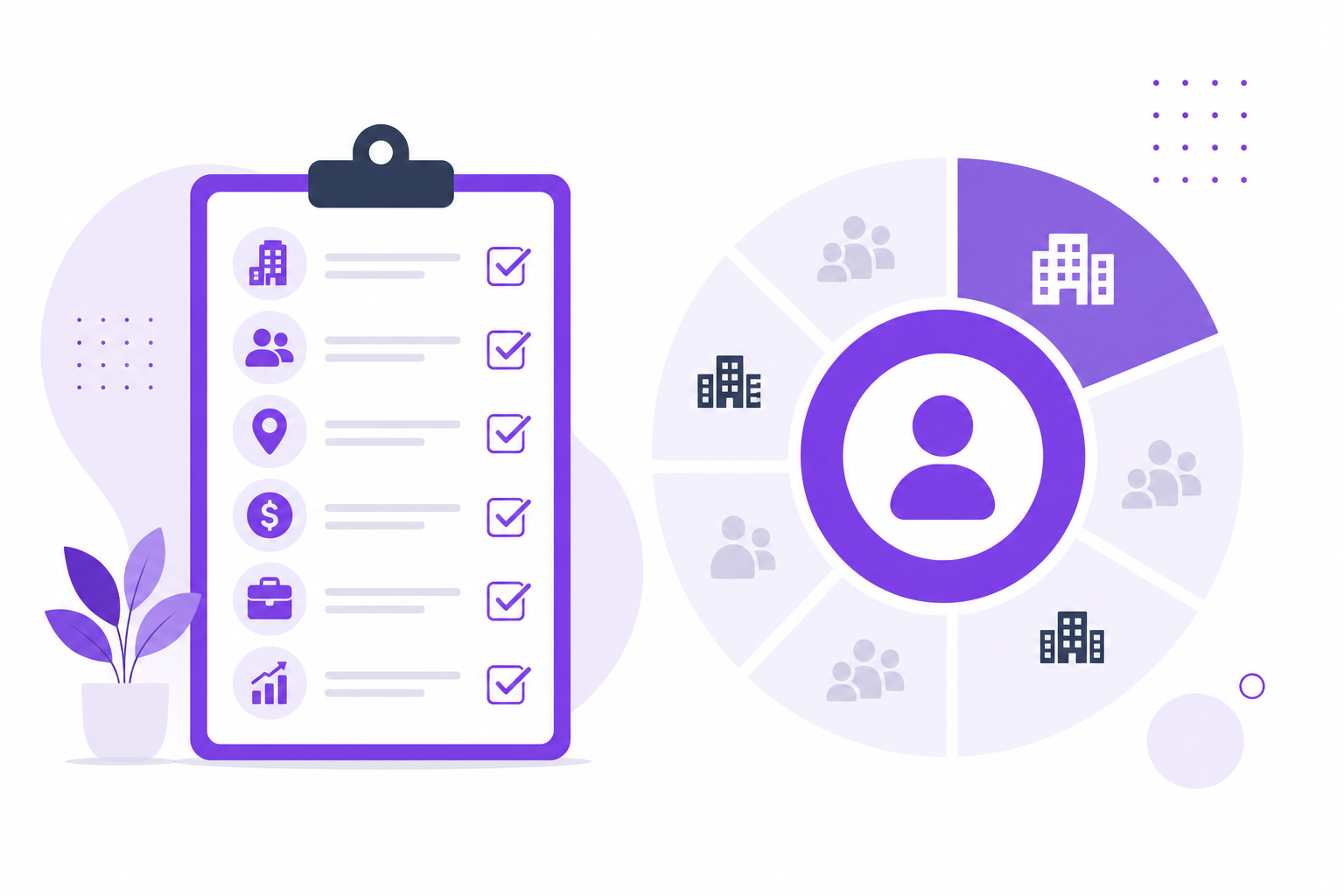
An Ideal Customer Profile is a detailed description of the company—not the individual person—that gets the most value from your product, closes fastest, pays reliably, and stays longest. It is a firmographic and behavioral blueprint for targeting.
ICP is often confused with buyer persona. The distinction matters:
- ICP: Company-level attributes (industry, size, geography, tech stack)
- Buyer persona: Individual-level attributes (role, goals, objections, communication style)
You need both. ICP determines which companies enter your pipeline. Personas determine how you message the people inside those companies.
Why ICP Matters for B2B Sales Performance
Teams without ICP discipline share common symptoms: low reply rates, long sales cycles, high churn, and AEs complaining about lead quality. A strong ICP fixes the root cause.
Benefits of a documented ICP:
- Focused prospecting—reps know exactly who to target
- Higher conversion rates at every funnel stage
- Better marketing spend allocation
- Faster onboarding for new SDRs and AEs
- Consistent qualification criteria across teams
- Improved product feedback loops from best-fit customers
- Accurate revenue forecasting based on real fit patterns
See ICP-first lead generation and how sales teams find qualified leads.
Step 1: Analyze Your Best Existing Customers
Start with data, not assumptions. Pull your top 20–50 customers ranked by:
- Revenue and contract value
- Profitability (if available)
- Sales cycle length (shorter is better)
- Retention and expansion revenue
- Product engagement and satisfaction scores
- Referrals and advocacy
Look for patterns. Which industries appear repeatedly? What company sizes dominate? Which geographies convert fastest? Which use cases drove the purchase decision?
Interview 5–10 best customers. Ask: Why did you buy? What alternatives did you consider? What almost stopped you? What results have you achieved? Customer voice reveals ICP nuances data alone misses.
Step 2: Analyze Lost Deals and Churned Accounts
Your worst customers teach as much as your best. Review:
- Deals lost in late stages—what firmographic patterns appear?
- Customers who churned within 12 months—what did they share?
- Accounts with high support burden relative to revenue
- Prospects disqualified during discovery—common reasons
Patterns here become disqualification criteria. If every company under 20 employees churns, that is an ICP boundary—not an opinion.
Step 3: Define Firmographic Criteria
Document the company attributes that predict success with your solution.
Industry and Vertical
List primary industries (top 3–5) and sub-verticals where you win. Be specific: "Healthcare" is too broad; "ambulatory surgery centers" or "dental practice management" is actionable.
Company Size
Define ranges by employee count and/or revenue. Example: 50–500 employees, $5M–$100M annual revenue. Include minimum and maximum thresholds.
Geography
Specify countries, regions, or metros you serve. Note regulatory or language requirements that limit certain markets.
Business Model
B2B vs. B2C, SaaS vs. services vs. manufacturing, franchise vs. independent. Your solution may fit one model dramatically better.
Growth Stage
Startup, growth-stage, mature enterprise. Buying behavior and budget authority differ significantly across stages.
Step 4: Add Technographic and Operational Criteria
For technology products especially, technographics predict fit:
- Current software stack (CRM, ERP, marketing tools)
- Cloud vs. on-premise infrastructure
- Integration requirements
- Technical team maturity
- Data volume or transaction scale
Operational criteria apply beyond software: production capacity, distribution model, compliance certifications, supply chain complexity. Match criteria to what actually predicts success with your offering.
Step 5: Identify Buying Triggers and Timing Signals
ICP fit without timing still produces slow pipeline. Document events that trigger purchase:
- Funding rounds or revenue milestones
- Leadership changes (new CTO, VP Sales)
- Regulatory or compliance deadlines
- Competitive displacement opportunities
- Geographic expansion
- Team growth in relevant departments
- Technology migration projects
- Pain events (outage, failed implementation, audit finding)
Triggers help SDRs prioritize ICP-fit accounts showing active buying signals. Learn lead qualification process for applying triggers in practice.
Step 6: Document Disqualification Criteria
A useful ICP includes who you do not sell to. Examples:
- Industries outside compliance scope
- Company size below minimum viable deal size
- Geographies you cannot support
- Business models incompatible with your product
- Companies in active contracts with competitors (unless displacement play)
- Organizations lacking budget authority structure
Disqualifiers prevent pipeline pollution and protect sales morale. Reps should feel empowered to say no to bad-fit prospects.
Step 7: Map Buyer Personas Within Your ICP
Once company ICP is defined, map the people inside those companies:
- Primary buyer: Role, title range, department
- Champion profile: Who advocates internally
- Technical evaluator: Who assesses implementation
- Economic buyer: Who signs the contract
Persona details include goals, KPIs, common objections, preferred communication channels, and content that resonates. See finding B2B decision-makers.
Step 8: Validate Your ICP With Data
Before rolling out ICP company-wide, validate against historical performance:
- Score last 100 closed-won deals against your ICP criteria
- Score last 50 closed-lost deals—where did they fail ICP?
- Calculate win rate for ICP-fit vs. non-ICP prospects
- Compare sales cycle length by ICP tier
- Compare retention and expansion by ICP segment
If ICP-fit deals do not outperform non-ICP deals, refine criteria. Your ICP should be predictive, not aspirational.
Step 9: Document and Distribute Your ICP
Create a one-to-two page ICP document accessible to sales, marketing, product, and customer success. Include:
- ICP summary statement (one paragraph)
- Firmographic criteria table
- Technographic/operational criteria
- Buying triggers list
- Disqualification criteria
- Buyer persona summaries
- Example companies (named or anonymized)
- Anti-examples (companies that look close but are not fit)
Review in new hire onboarding. Reference in pipeline reviews. Update quarterly.
Step 10: Apply ICP to Prospecting and Lead Generation
ICP is useless if not operationalized. Apply it to:
- List building: Filter every prospect database query by ICP criteria
- Lead scoring: Weight fit score heavily in prioritization
- Content marketing: Create assets for ICP industries and use cases
- Paid advertising: Target ICP firmographics on LinkedIn and Google
- Event selection: Attend conferences where ICP companies gather
- Partnership strategy: Partner with vendors serving same ICP
Execute with B2B prospecting workflow, sales prospecting guide, and finding qualified B2B leads.
Using AI to Build and Apply Your ICP
AI accelerates ICP work in three ways:
- ICP generation: Analyze your customer data and market to suggest ICP criteria
- Prospect discovery: Find companies matching ICP across large databases
- Fit scoring: Automatically rank prospects by ICP alignment
AI ICP tools do not replace customer interviews and win/loss analysis—they amplify pattern recognition across datasets too large for manual review. Read AI ICP Generator explained and how AI qualifies B2B leads.
ICP Tiers: Primary, Secondary, and Tertiary
Not all ICP-fit companies are equal. Tier your ICP for resource allocation:
- Tier 1 (Primary ICP): Highest win rate, fastest cycle, best retention—gets most SDR/AE time
- Tier 2 (Secondary ICP): Good fit with longer cycle or lower ACV—nurture and standard outreach
- Tier 3 (Tertiary/Experimental): Emerging segments being tested—limited investment, measured results
Tiering prevents treating every ICP-fit account identically when resources are finite.
When and How to Update Your ICP
ICP is not static. Review quarterly and update when:
- Product launches new features expanding addressable market
- Win/loss patterns shift significantly
- Churn clusters in a previously strong segment
- Company pivots upmarket or downmarket
- Competitive landscape changes buying behavior
- New vertical shows unexpectedly strong traction
Version your ICP document. Communicate changes to sales and marketing with rationale, not just new rules.
Common ICP Building Mistakes
- Building ICP from aspiration instead of customer data
- Defining ICP too broadly ("any B2B company")
- Ignoring disqualification criteria
- Creating ICP once and never revisiting
- Sales and marketing using different ICP definitions
- Including only firmographics without buying triggers
- Not validating ICP against win/loss data
- Confusing ICP with total addressable market (TAM)
ICP Template for B2B Sales Teams
Use this structure to document your ICP:
| Category | Criteria | Example |
|---|---|---|
| Industry | Primary verticals | SaaS, professional services, manufacturing |
| Company size | Employees / revenue | 100–1,000 employees, $10M–$100M revenue |
| Geography | Target markets | North America, UK, DACH |
| Technographics | Tech stack signals | Uses Salesforce, cloud-native |
| Buying triggers | Timing signals | Series B funding, new VP Sales hire |
| Disqualifiers | Who to avoid | <20 employees, government, non-English |
Frequently Asked Questions
How do you build an ideal customer profile for B2B sales?
Analyze your best customers by revenue, retention, and sales cycle. Define firmographic criteria (industry, size, geography), technographics, buying triggers, and disqualifiers. Validate against win/loss data, document in a shared template, and apply to prospecting and lead scoring.
What is the difference between ICP and buyer persona?
ICP describes the ideal company (firmographic and operational attributes). Buyer persona describes the ideal individual contact (role, goals, objections). ICP determines which companies to target; personas determine how to message people within those companies.
How often should you update your ICP?
Review ICP quarterly at minimum. Update when product changes, win/loss patterns shift, churn clusters emerge, or the company pivots market focus. Major product launches or market entries warrant immediate ICP review.
Can AI build an ICP for my company?
AI can analyze customer data, market patterns, and firmographic signals to suggest ICP criteria and discover matching prospects. Human validation through customer interviews and win/loss analysis remains essential for accuracy.
How many industries should an ICP include?
Most B2B companies perform best with 3–5 primary industries where they have proven traction. More than that dilutes messaging and expertise. Start focused, expand only with validated win data in new verticals.
Final Thoughts
Building an ideal customer profile is not a one-time workshop exercise—it is an ongoing discipline that separates high-performing B2B sales teams from everyone else. Start with your best customers. Document what makes them ideal. Define who does not fit. Validate with data. Apply everywhere.
Every hour your team spends on ICP-fit prospects returns more than hours spent on random outreach. The ICP you build today becomes the targeting engine for pipeline, content, partnerships, and product strategy tomorrow.
Ready to build and apply your ICP at scale? Get started with Adsaga.ai or explore more sales guides on the Adsaga blog.
How Adsaga.ai Helps You Build and Apply Your ICP
Adsaga.ai turns ICP definition into actionable prospecting. The platform's AI ICP Generator analyzes your criteria and discovers companies that match—complete with decision-maker contacts and fit scores.
With Adsaga.ai, B2B sales teams can:
- Generate ICP criteria from your product and market inputs
- Discover companies matching your ICP across industries and geographies
- Score prospects automatically by firmographic and fit alignment
- Find verified decision-makers within ICP-fit accounts
- Reduce wasted outreach on companies outside your profile
- Align SDR prospecting with documented ICP tiers
Build your ICP using the framework in this guide—then use Adsaga.ai to find every company that fits. Try Adsaga.ai and make ICP-driven prospecting your competitive advantage in 2026.