
In today's competitive B2B market, generating thousands of leads is no longer enough. The real challenge is identifying prospects that closely match your Ideal Customer Profile (ICP). While many businesses purchase bulk lead lists hoping to accelerate sales, these lists often result in low response rates, wasted outreach efforts, and poor conversion performance.
ICP-based lead generation takes a different approach. Instead of focusing on volume, it prioritizes quality by targeting companies and decision-makers that are most likely to become customers. This strategy helps sales teams spend less time qualifying leads and more time closing deals.
In this guide, you'll learn why ICP-first lead generation consistently outperforms bulk lead lists and how businesses can build a scalable B2B lead generation process around their ideal customers.
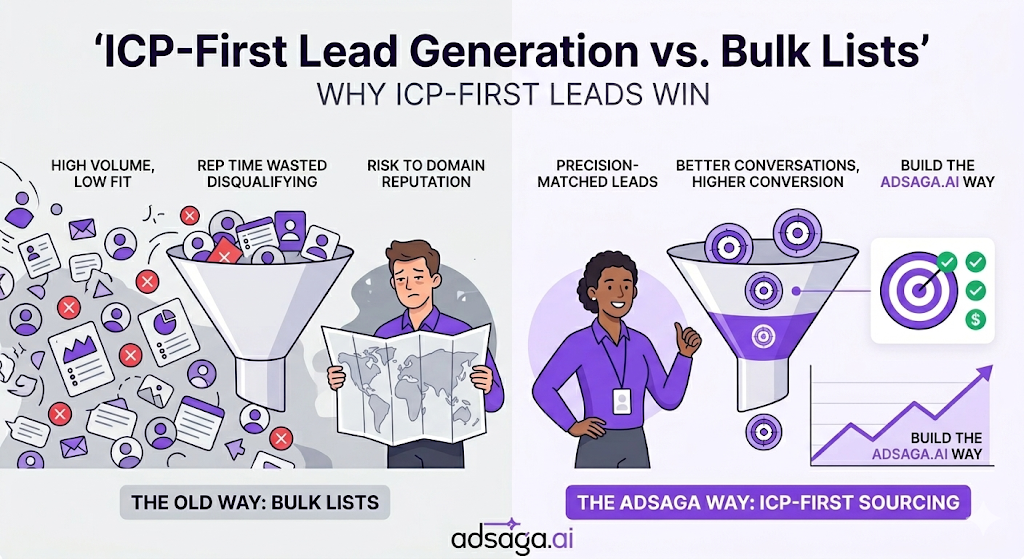
What Is ICP-Based Lead Generation?
ICP lead generation is a targeted approach to lead prospecting where businesses identify and reach companies that closely match their ideal customer profile. Rather than casting a wide net, ICP-based strategies focus on organizations that share common traits with your best existing customers.
An ideal customer profile typically includes firmographic data (industry, company size, revenue, geography), technographic signals (tools and platforms in use), and behavioral indicators such as hiring patterns, funding rounds, or expansion activity. When your lead sourcing aligns with this profile, every contact in your CRM becomes a potential conversation—not a disqualification exercise.
Modern lead generation services like Adsaga.ai use your website and positioning as the starting brief, ensuring that outbound lists reflect how you actually sell—not a generic industry dump.
Why Bulk Lead Lists Fail
Bulk lead lists promise speed: thousands of contacts, instant download, immediate outreach. The problem is that volume without fit creates downstream chaos for sales and marketing teams alike.
- Wrong titles and roles — Contacts who never influence or approve purchases.
- Stale or unverified data — Bounced emails that damage sender reputation.
- Industry mismatch — Companies outside your serviceable market or price band.
- No buying intent — Accounts with zero trigger events or active need.
The result? SDRs burn hours on sales prospecting that never converts. Marketing reports inflated top-of-funnel numbers while pipeline quality collapses. This is why experienced B2B teams are shifting from bulk databases to ICP-focused lead generation services that deliver verified leads from day one.
The Hidden Costs of Buying Bulk B2B Leads
The sticker price of a bulk list is only the beginning. The true cost of bad-fit B2B sales leads shows up across your entire revenue engine:
You pay for the list once—and pay again every time a rep dials the wrong person, sends a bounced email, or books a meeting with a prospect who was never going to buy.
- Rep time wasted disqualifying — High-volume lists force SDRs to act as data cleaners instead of closers.
- Domain reputation risk — High bounce rates and spam complaints hurt deliverability for your entire organization.
- Low connect and reply rates — Prospects who don't recognize their problem in your pitch simply ignore you.
- Forecast unreliability — Leadership can't trust pipeline when lead quality swings wildly week to week.
Before importing your next batch, run it through a lead verification checklist. If more than fifteen percent fails basic fit checks, fix sourcing—not sequences.
Benefits of ICP-First Lead Generation
When lead sourcing starts with a clear ideal customer profile, the entire go-to-market motion becomes more predictable. Here are the four benefits teams report first:
Higher Response Rates
Prospects respond when messaging speaks to their actual situation. ICP-matched contacts already fit your target industry, company size, and role—so your value proposition lands faster. Teams using ICP-first outreach typically see meaningfully higher reply rates compared to generic bulk campaigns.
Better Meeting Quality
Discovery calls with ICP-fit prospects feel like expansion conversations, not education from zero. Reps spend time on high intent leads who understand the problem category and have budget authority—or know who does.
Lower Customer Acquisition Cost
Fewer wasted touches mean lower cost per qualified opportunity. Instead of paying SDRs to filter bad data, ICP-based lead generation puts qualified leads directly into the pipeline—reducing the total activities required to book a meeting.
Improved Sales Productivity
When CRM records are trustworthy, sales trusts marketing. Reps stop maintaining shadow spreadsheets and focus on sales prospecting that converts. That productivity gain compounds across quarters.
How to Create an Ideal Customer Profile
Building an ICP doesn't require a six-month consulting project. Start with evidence from customers you already won:
- Analyze closed-won deals — Pull your last 50–100 wins. What industries, company sizes, and titles repeat?
- Interview your best reps — Ask which prospects close fastest and why.
- Define firmographic guardrails — Set ranges for employee count, revenue, geography, and vertical.
- Identify trigger events — Hiring, funding, tech adoption, or regulatory changes that signal need.
- Document negative fit — Equally important: who is not your customer and why deals stall.
Your ICP should be specific enough to filter a list but flexible enough to capture adjacent segments that convert. Review and refine it quarterly as your product and market evolve.
ICP Lead Generation Process Used By Modern B2B Teams
High-performing teams follow a repeatable workflow rather than one-off list purchases:
- Anchor on positioning — Your website URL and value proposition define who you serve.
- Source ICP-fit contacts — Filter by role, firmographics, and intent—not generic industry tags.
- Verify before import — Confirm deliverability, title accuracy, and company match. See our guide on how to verify B2B leads.
- Deliver CRM-ready files — Sales works consistent columns every week.
- Measure quality, not just volume — Track meetings booked, pipeline created, and win rate—not dial count.
This workflow aligns with our complete B2B lead generation guide: from your link to verified, ICP-matched leads without relying on paid ads.
Case Example: From Bulk Lists to ICP-Focused Lead Sourcing
Consider a mid-market SaaS company selling project-management software to construction firms with 50–500 employees. Their team purchased a 10,000-contact bulk list filtered only by "construction industry."
After two weeks: 34% of emails bounced, SDRs reported that most contacts were field supervisors—not the VP Operations or IT directors who approve software purchases. Meeting show rates dropped. The sales director paused outreach entirely.
Switching to ICP-first sourcing changed the math. The new criteria: construction companies, 50–500 employees, North America, targeting VP Operations, Director of IT, and CFO titles. List size dropped to 800 contacts—but connect rates tripled, and qualified meetings increased 4× within the first month.
The lesson: smaller lists of verified leads that match your ideal customer profile outperform massive databases every time.
Why Businesses Are Switching to ICP-Focused Lead Sourcing
B2B buyers are harder to reach, more informed, and less tolerant of irrelevant outreach. Bulk lists built for a different era can't keep up. Teams that invest in ICP-based lead generation gain:
- Predictable weekly pipeline instead of campaign spikes
- Stronger alignment between marketing and sales on lead quality
- Protection of domain reputation through verified, deliverable contacts
- Scalable lead generation services that grow with segment expansion—not chaos
Whether you're a SaaS company, marketing agency, IT services firm, consultant, or manufacturer, ICP-focused prospecting adapts to your market. The companies winning in 2026 aren't buying more leads—they're buying better-fit leads.
Frequently Asked Questions
What is ICP in lead generation?
ICP (Ideal Customer Profile) is a description of the companies most likely to buy your product or service based on industry, company size, location, revenue, and buying intent.
Why are bulk lead lists ineffective?
Bulk lead lists often contain unqualified contacts, outdated information, and businesses that are not a good fit, resulting in low conversion rates.
How does ICP-based lead generation improve sales?
ICP-based lead generation focuses only on high-fit prospects, increasing reply rates, meeting quality, and overall sales efficiency.
What industries benefit from ICP lead generation?
SaaS companies, marketing agencies, IT service providers, consultants, manufacturers, and B2B businesses benefit significantly from ICP-focused prospecting.
Conclusion
The shift from bulk lead lists to ICP-based lead generation is not a trend—it's a response to how B2B buyers behave today. Volume without fit wastes rep time, damages deliverability, and erodes pipeline trust. ICP-first sourcing delivers qualified leads, better meetings, and a sales motion your team can actually scale.
Start by auditing your closed-won deals, defining your ideal customer profile, and verifying every contact before it hits your CRM. When you're ready to automate ICP-fit sourcing, share your link with Adsaga.ai—we deliver verified, ICP-matched B2B sales leads straight to your workflow. You can also explore our B2B lead generation platform or read more on the Adsaga blog.