
Introduction
B2B lead generation is the process of identifying and attracting potential business customers who may be interested in your products or services. Whether you're a SaaS company, marketing agency, IT service provider, consultant, or manufacturer, generating qualified leads is essential for sustainable business growth.
In 2026, B2B lead generation has evolved far beyond buying contact lists and sending mass emails. Today's successful sales teams focus on Ideal Customer Profiles (ICP), lead verification, sales prospecting, personalized outreach, and automation to consistently generate high-quality leads.
In this guide, you'll learn what B2B lead generation is, how it works, the best lead generation strategies for 2026, and how to generate qualified leads that convert into customers and fuel a predictable B2B sales pipeline.
For deeper process context, see our B2B Sales Prospecting Guide (2026) and Top B2B Lead Generation Mistakes That Cost Companies Revenue.
Related guides: ICP-Based Lead Generation vs Bulk Lists, How to Identify Your Ideal Customer Profile (ICP) for Better Lead Generation, How to Find Qualified B2B Leads That Actually Convert, How to Verify B2B Leads Before Starting Outreach, and How to Build a Predictable B2B Sales Pipeline in 2026.
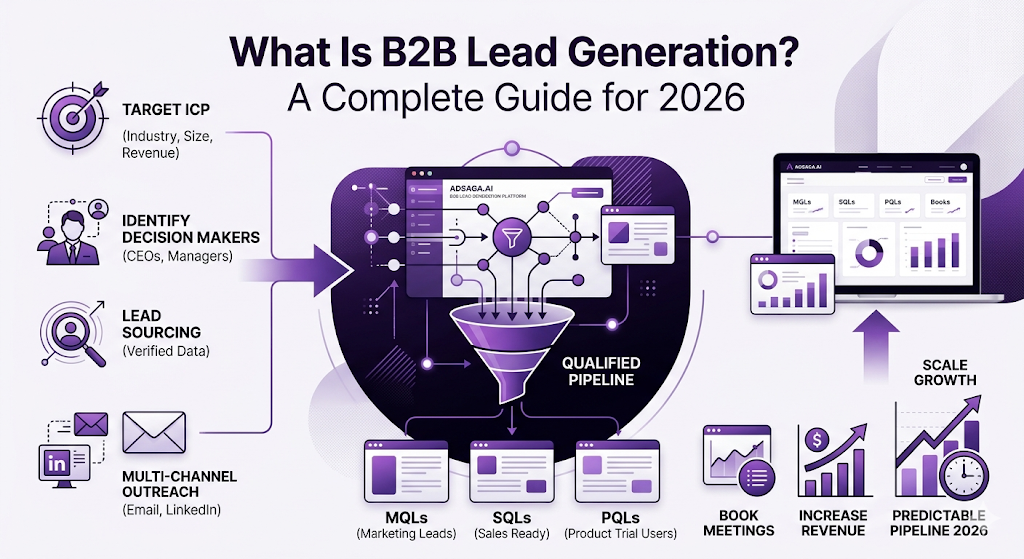
What Is B2B Lead Generation?
B2B lead generation refers to the process of finding and engaging businesses that could potentially become customers. A lead is typically a person within a company who has shown interest in your solution or matches your target customer profile.
The goal of B2B lead generation is to:
- Find potential customers
- Identify decision-makers
- Generate interest
- Schedule meetings
- Convert prospects into paying customers
Unlike B2C marketing, where companies sell directly to consumers, B2B sales often involve multiple stakeholders, longer sales cycles, and higher-value transactions.
Why B2B Lead Generation Is Important
Without a consistent flow of qualified leads, even the best products struggle to grow. Effective B2B lead generation helps businesses:
- Increase revenue opportunities
- Improve sales productivity
- Reduce customer acquisition costs
- Build a predictable sales pipeline
- Target high-value customers
- Scale business growth
Companies that consistently generate qualified leads are better positioned to achieve long-term growth and outperform competitors.
How the B2B Lead Generation Process Works
A successful lead generation process typically follows these steps:
1. Define Your Ideal Customer Profile (ICP)
An Ideal Customer Profile represents the type of company most likely to benefit from your product or service. Factors include industry, company size, revenue, location, technology stack, and growth stage. The more specific your ICP, the higher the quality of leads you'll generate. Learn more in our ICP-based lead generation guide.
2. Identify Decision Makers
Once you know which companies fit your ICP, identify key stakeholders such as CEOs, founders, marketing directors, sales leaders, operations managers, and IT decision makers. Reaching the right person significantly improves response rates.
3. Source Qualified Leads
Lead sourcing involves collecting relevant prospect information including name, job title, company, email address, LinkedIn profile, and company details. Modern sales teams focus on quality rather than volume.
4. Verify Contact Information
Data quality directly impacts outreach performance. Lead verification helps ensure emails are valid, contacts are current, and companies match ICP requirements. See our checklist on how to verify B2B leads.
5. Launch Outreach Campaigns
Sales teams engage prospects through cold email, LinkedIn outreach, phone calls, content marketing, and paid advertising. Personalized outreach generally performs better than generic messaging.
6. Book Meetings and Close Deals
The ultimate goal is converting qualified leads into sales opportunities and customers.
Types of B2B Leads
Marketing Qualified Leads (MQLs)
Prospects who have interacted with marketing content but are not yet ready to purchase — for example, downloading guides, attending webinars, or subscribing to newsletters.
Sales Qualified Leads (SQLs)
Prospects who have demonstrated buying intent and are ready for direct sales engagement — such as requesting demos, scheduling meetings, or responding positively to outreach.
Product Qualified Leads (PQLs)
Common in SaaS businesses, these users experience product value before purchasing — free trial users, freemium users, and active platform users.
Best B2B Lead Generation Strategies for 2026
1. ICP-Based Lead Generation
Instead of targeting everyone, focus on companies that closely match your ideal customer profile. Benefits include better conversion rates, higher-quality meetings, and reduced prospecting costs.
2. LinkedIn Prospecting
LinkedIn remains one of the most powerful B2B prospecting channels. Sales teams use it to identify decision-makers, build relationships, share valuable content, and start conversations.
3. Content Marketing
Educational content helps attract potential customers organically through blog posts, case studies, whitepapers, industry reports, and webinars. Content marketing builds trust and authority.
4. Email Outreach
Cold email remains highly effective when targeting the right audience with personalized messaging. Successful campaigns focus on relevance, personalization, value, and clear calls-to-action.
5. Referral Programs
Satisfied customers often become valuable lead sources. Referrals typically generate higher trust, shorter sales cycles, and better close rates.
6. Search Engine Optimization (SEO)
SEO helps businesses attract inbound leads through organic search. Ranking for terms such as B2B lead generation, sales prospecting, lead sourcing, and qualified leads can generate consistent traffic and opportunities.
Common B2B Lead Generation Mistakes
Buying Massive Lead Lists
Large databases often contain outdated contacts, poor-fit companies, and low-quality information. Quantity rarely beats quality.
Ignoring Lead Verification
Invalid contact information leads to high bounce rates, lower deliverability, and wasted sales efforts.
Weak ICP Definition
Many businesses target broad audiences and struggle to achieve meaningful results. A clear ICP improves every stage of lead generation.
Generic Outreach
Prospects ignore messages that feel automated and irrelevant. Personalization significantly improves engagement.
How to Measure B2B Lead Generation Success
Track the following metrics:
- Lead volume — total number of leads generated
- Lead quality — percentage of leads that match your ICP
- Response rate — percentage of prospects who engage with outreach
- Meeting booking rate — percentage who schedule meetings
- Opportunity conversion rate — percentage of meetings that become sales opportunities
- Customer acquisition cost (CAC) — cost to acquire a new customer
The Future of B2B Lead Generation
In 2026 and beyond, successful companies are moving toward AI-powered prospecting, automated lead sourcing, intent-based targeting, data verification, hyper-personalized outreach, and predictive lead scoring. Businesses that combine automation with accurate data and strong ICP targeting will have a significant competitive advantage.
Adsaga.ai helps teams automate ICP lead generation and deliver verified B2B sales leads with decision makers built in—combining lead sourcing, lead verification, and workflow automation so your team focuses on outreach that converts, not manual list building.
Frequently Asked Questions
What is B2B lead generation?
B2B lead generation is the process of identifying and attracting businesses that may become customers for your products or services.
What are qualified B2B leads?
Qualified leads are prospects that match your Ideal Customer Profile and have a higher likelihood of becoming customers.
Why is lead verification important?
Lead verification ensures contact information is accurate, reducing bounce rates and improving outreach effectiveness.
What is an Ideal Customer Profile (ICP)?
An ICP is a description of the companies most likely to benefit from your solution based on factors such as industry, company size, location, and revenue.
What is the best B2B lead generation strategy?
ICP-based lead generation combined with verified prospect data, personalized outreach, and consistent follow-up is one of the most effective strategies.
Conclusion
B2B lead generation is no longer about collecting as many contacts as possible. Success comes from identifying the right companies, targeting the right decision-makers, verifying data, and delivering relevant outreach.
Businesses that prioritize quality over quantity consistently generate better meetings, stronger sales opportunities, and higher revenue growth. By implementing an ICP-focused lead generation strategy, organizations can build a predictable pipeline and create a scalable foundation for long-term success.
Share your ICP with Adsaga.ai for ICP-matched, verified leads weekly—or explore more on the Adsaga blog, including how to find qualified B2B leads and why ICP-first sourcing beats bulk lists.