
Introduction
A predictable B2B sales pipeline is one of the most valuable assets a business can have. When your pipeline consistently generates qualified leads, sales forecasting becomes easier, revenue growth becomes more stable, and your team spends less time chasing unqualified prospects.
Unfortunately, many businesses operate with an unpredictable pipeline. Some months are full of meetings, while others struggle to generate enough opportunities to hit revenue targets. This inconsistency often results from poor lead quality, unclear targeting, and inconsistent sales prospecting efforts.
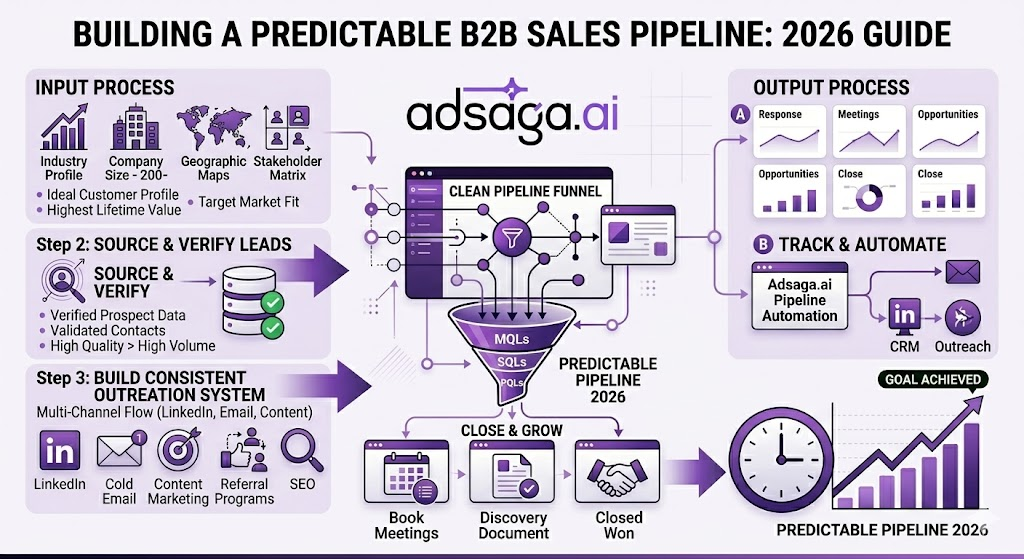
In this guide, you'll learn how to build a predictable B2B sales pipeline in 2026—using ICP lead generation, lead verification, structured outreach, pipeline automation, and B2B pipeline management practices that strengthen your entire sales funnel and support a long-term B2B growth strategy.
For deeper process context, see our B2B Sales Prospecting Guide (2026) and Top B2B Lead Generation Mistakes That Cost Companies Revenue.
Related guides: What Is B2B Lead Generation? A Complete Guide for 2026, ICP-Based Lead Generation vs Bulk Lists, How to Identify Your Ideal Customer Profile (ICP) for Better Lead Generation, How to Find Qualified B2B Leads That Actually Convert, and How to Verify B2B Leads Before Starting Outreach.
What Is a B2B Sales Pipeline?
A B2B sales pipeline is a structured process that tracks potential customers from initial contact to becoming paying clients. A typical sales pipeline includes:
- Lead Generation
- Lead Qualification
- Initial Outreach
- Discovery Meeting
- Proposal Stage
- Negotiation
- Closed Won
The purpose of a sales pipeline is to create a repeatable system for converting prospects into customers.
Why Most B2B Sales Pipelines Fail
Many companies struggle with pipeline consistency because they focus on volume rather than quality. Common reasons include:
- Poor lead quality
- Undefined Ideal Customer Profile (ICP)
- Inconsistent prospecting
- Outdated contact data
- Weak follow-up processes
- Lack of lead verification
- No clear sales process
Without a structured approach, even experienced sales teams can experience unpredictable results.
Step 1: Define Your Ideal Customer Profile (ICP)
The foundation of every predictable sales pipeline starts with a clear Ideal Customer Profile. Your ICP should define:
Industry
Which industries generate the highest customer lifetime value?
Company Size
Do you primarily sell to startups, SMBs, mid-market companies, or enterprises?
Geographic Location
Which regions produce the best opportunities?
Revenue Range
What company revenue levels align with your solution?
Decision Makers
Who typically approves purchasing decisions?
A strong ICP helps eliminate low-quality prospects before they enter your pipeline. Read our ICP-based lead generation guide for a deeper dive.
Step 2: Focus on Lead Quality Over Lead Quantity
One of the biggest mistakes businesses make is measuring success by the number of leads generated. More leads do not automatically mean more revenue.
For example, 5,000 random contacts may generate very few meetings, while 500 verified ICP-matched prospects can generate significantly better results.
High-quality leads typically match your ICP, have valid contact information, fit your target market, and demonstrate potential buying intent. Quality creates predictability.
Step 3: Build a Consistent Lead Generation System
Predictable pipelines require consistent lead flow. Effective lead generation channels include:
LinkedIn Prospecting
LinkedIn remains one of the best channels for finding B2B decision-makers.
Cold Email Outreach
Targeted email campaigns can generate meetings at scale when supported by accurate data.
Content Marketing
Publishing valuable content attracts prospects actively researching solutions.
Referral Programs
Customer referrals often convert faster and at higher rates.
SEO
Ranking for high-intent search terms helps generate inbound opportunities consistently — such as B2B lead generation, sales prospecting, lead sourcing, qualified leads, and pipeline automation. See our complete B2B lead generation guide.
Step 4: Verify Every Lead Before Outreach
Lead verification is often overlooked but has a major impact on pipeline performance. Invalid emails and outdated contacts lead to lower response rates, higher bounce rates, poor sender reputation, and wasted SDR effort.
Before outreach, verify email addresses, job titles, company information, and decision-maker relevance. Verified leads improve campaign performance and increase meeting booking rates.
Step 5: Create a Repeatable Outreach Process
Consistency is critical. Many sales teams stop after one email or one LinkedIn message. Effective outreach typically includes:
- Touchpoint 1: Introduction email
- Touchpoint 2: LinkedIn connection request
- Touchpoint 3: Follow-up email
- Touchpoint 4: Value-focused message
- Touchpoint 5: Final follow-up
Most positive responses occur after multiple touchpoints. A structured follow-up process dramatically improves pipeline consistency.
Step 6: Track Key Pipeline Metrics
Predictable growth requires measurement. Important metrics include:
- Leads generated — how many qualified leads enter the pipeline
- Response rate — how many prospects engage with outreach
- Meeting booking rate — how many responses become meetings
- Opportunity rate — how many meetings become opportunities
- Close rate — how many opportunities become customers
- Customer acquisition cost (CAC) — cost to acquire a new customer
These metrics help identify bottlenecks and improve performance.
Step 7: Automate Repetitive Tasks
Modern sales teams use automation to increase efficiency. Automation can help with lead sourcing, lead verification, CRM updates, outreach sequences, follow-up reminders, and pipeline reporting — allowing sales representatives to focus on conversations instead of administrative work.
Adsaga.ai helps teams automate ICP lead generation and deliver verified, CRM-ready qualified leads—combining lead verification, lead sourcing, and pipeline automation so your team builds a more predictable B2B sales pipeline without manual list building.
Step 8: Keep Your CRM Clean
A cluttered CRM makes forecasting difficult. Regularly remove duplicate records, inactive prospects, invalid contacts, and closed-lost opportunities that are no longer relevant. A clean CRM provides accurate pipeline visibility and better decision-making.
The Predictable Pipeline Formula
Many successful B2B companies follow a simple formula:
Define ICP
↓
Source Qualified Leads
↓
Verify Contact Data
↓
Consistent Outreach
↓
Book Meetings
↓
Create Opportunities
↓
Close Deals
When each stage operates consistently, pipeline growth becomes predictable.
Common Mistakes to Avoid
Chasing Every Prospect
Not every company is a good fit.
Buying Large Bulk Lists
Quantity often creates more noise than opportunities.
Skipping Lead Verification
Bad data reduces campaign effectiveness.
Inconsistent Prospecting
Pipeline health depends on consistent activity.
Weak Follow-Up
Many opportunities are lost simply because teams stop following up too early.
How Modern B2B Teams Build Pipeline Faster
Today's highest-performing sales teams use ICP-based lead generation, verified prospect data, sales automation, personalized outreach, and data-driven optimization. Instead of relying on random lead lists, they focus on creating repeatable systems that consistently generate qualified opportunities.
Frequently Asked Questions
What is a B2B sales pipeline?
A B2B sales pipeline is a structured process used to track prospects from initial contact through becoming customers.
How do I make my sales pipeline predictable?
Focus on ICP targeting, verified leads, consistent prospecting, structured outreach, and performance tracking.
What is the most important part of pipeline building?
Defining your Ideal Customer Profile and maintaining lead quality are the most important factors.
How many leads do I need to build a pipeline?
The number depends on your conversion rates, but qualified leads are significantly more valuable than large quantities of unqualified contacts.
Why is lead verification important?
Lead verification ensures outreach reaches the correct people, improving response rates and meeting quality.
Conclusion
Building a predictable B2B sales pipeline is not about generating more leads—it's about generating the right leads consistently.
Businesses that define their ICP, verify prospect data, maintain structured outreach processes, and track performance metrics create stronger pipelines and more reliable revenue growth.
By focusing on quality, consistency, and automation, sales teams can build a pipeline that delivers qualified opportunities month after month. Share your ICP with Adsaga.ai for ICP-matched, verified leads weekly—or explore more on the Adsaga blog, including how to find qualified B2B leads and common lead generation mistakes to avoid.