
Introduction
Generating leads is easy. Generating qualified B2B leads that turn into meetings, opportunities, and customers is where most businesses struggle.
Many companies spend thousands of dollars on B2B lead generation campaigns, purchase massive contact lists, or run outreach programs that produce little to no return. The problem isn't usually a lack of leads—it's a lack of qualified leads.
A qualified B2B lead is a prospect that matches your Ideal Customer Profile (ICP), has a genuine need for your solution, and is likely to become a customer.
In this guide, you'll learn how to find qualified B2B leads that actually convert in 2026—using ICP lead generation, lead verification, sales prospecting, lead sourcing, and a B2B outreach strategy that drives pipeline growth.
For deeper process context, see our B2B Sales Prospecting Guide (2026) and Top B2B Lead Generation Mistakes That Cost Companies Revenue.
Related guides: What Is B2B Lead Generation? A Complete Guide for 2026, How to Identify Your Ideal Customer Profile (ICP) for Better Lead Generation, ICP-Based Lead Generation vs Bulk Lists, How to Verify B2B Leads Before Starting Outreach, and How to Find Decision Makers for B2B Sales and Lead Generation.
What Are Qualified B2B Leads?
A qualified B2B lead is a company or decision-maker that fits your target audience and has a realistic chance of purchasing your product or service.
Qualified leads typically meet criteria such as:
- Match your Ideal Customer Profile (ICP)
- Operate in your target industry
- Have the appropriate company size
- Possess buying authority
- Have a business need your solution can solve
- Are within your target market
Not every lead is qualified. The goal is to identify the prospects most likely to become paying customers.
Why Most B2B Lead Generation Fails
Many businesses focus on quantity rather than quality.
Common mistakes include:
Buying Large Contact Lists
Bulk lists often contain:
- Outdated information
- Irrelevant contacts
- Poor-fit companies
- Invalid email addresses
See why ICP-first sourcing outperforms bulk lists.
Targeting Everyone
Trying to sell to every industry, company size, and decision-maker usually results in poor conversion rates.
Skipping Lead Verification
Unverified data wastes sales time and damages outreach performance. Learn more in our guide on how to verify B2B leads before outreach.
Generic Outreach
Personalized messages consistently outperform mass email campaigns.
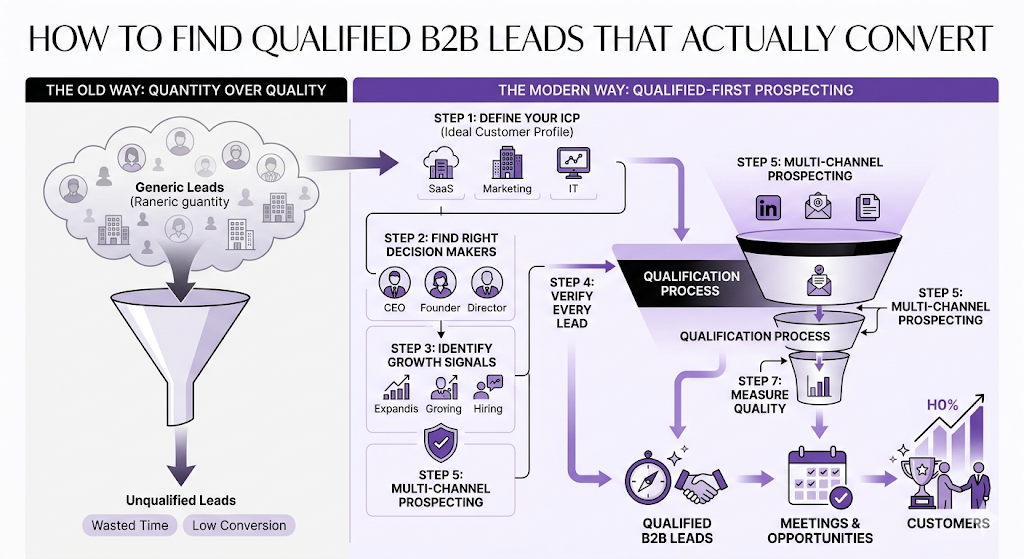
The solution is building a lead generation process focused on qualification from the start.
Step 1: Define Your Ideal Customer Profile (ICP)
The foundation of finding qualified leads starts with identifying your Ideal Customer Profile.
Ask yourself:
Which industries buy from us most often?
Examples:
- SaaS companies
- Marketing agencies
- IT service providers
- Recruitment firms
- Professional services companies
What company size works best?
- Startups
- Small businesses
- Mid-market companies
- Enterprises
Which geographic markets perform best?
- United States
- Canada
- United Kingdom
- Australia
- Europe
What common challenges do customers face?
Understanding these factors helps eliminate low-quality prospects before outreach begins. Use our ICP identification guide for a step-by-step framework.
Step 2: Identify the Right Decision Makers
Even if you target the correct company, reaching the wrong person can prevent deals from happening.
Common decision-makers include:
Founders and CEOs
Often responsible for strategic purchases.
Marketing Directors
Typically involved in growth-related decisions.
Sales Directors
Interested in solutions that improve pipeline performance.
Operations Managers
Focused on efficiency and process improvements.
Business Development Leaders
Responsible for revenue generation and partnerships.
The closer you get to the actual buyer, the higher your chances of success.
Step 3: Focus on Lead Quality Signals
Qualified prospects often display specific characteristics.
Growth Signals
Companies that are actively growing are more likely to invest in new solutions.
Examples:
- Hiring new employees
- Expanding into new markets
- Launching new products
Funding Activity
Recently funded businesses often have budgets allocated for growth initiatives.
Technology Usage
Companies already using complementary tools may be easier to convert.
Market Demand
Organizations facing industry-specific challenges are often more receptive to relevant solutions.
These signals help prioritize leads with stronger buying potential.
Step 4: Verify Every Lead
Lead verification is one of the most overlooked parts of B2B lead generation.
Before contacting prospects, verify:
- Email addresses
- Job titles
- Company information
- Decision-maker status
Benefits of lead verification include:
- Lower bounce rates
- Better email deliverability
- Improved response rates
- Higher meeting quality
Verified data creates a stronger foundation for outreach success.
Step 5: Use Multi-Channel Prospecting
Relying on a single channel limits your results.
Modern B2B sales teams use multiple prospecting channels.
LinkedIn Prospecting
LinkedIn remains one of the most effective platforms for identifying decision-makers and starting conversations.
Cold Email Outreach
Personalized email campaigns can scale outreach while maintaining relevance.
Content Marketing
Educational content attracts prospects actively searching for solutions.
Referrals
Satisfied customers can become valuable sources of qualified leads.
Using multiple channels increases visibility and improves conversion opportunities.
Step 6: Personalize Your Outreach
Generic messages rarely generate meaningful responses.
Effective outreach should reference:
- Industry challenges
- Company goals
- Recent business developments
- Relevant pain points
For example:
Instead of saying:
"Would you like to learn more about our services?"
Say:
"I noticed your company is actively expanding its sales team. We help growing businesses generate verified B2B leads and build predictable pipelines."
Specificity creates relevance.
Step 7: Measure Lead Quality
Many businesses only measure the number of leads generated.
The real focus should be lead quality.
Track metrics such as:
Response Rate
How many prospects engage with outreach?
Meeting Booking Rate
How many responses become meetings?
Opportunity Rate
How many meetings become sales opportunities?
Close Rate
How many opportunities become customers?
Customer Lifetime Value
How valuable are the customers generated?
Quality metrics provide better insight than lead volume alone. Tie this into your broader process with our guide on building a predictable B2B sales pipeline.
Characteristics of High-Quality B2B Leads
The best B2B leads generally have the following characteristics:
- Match your ICP
- Have a clear business need
- Include decision-makers
- Use valid contact information
- Fit your budget requirements
- Show signs of growth or intent
- Operate within your target market
When multiple factors align, conversion rates typically increase.
Common Mistakes to Avoid
Chasing Lead Volume
More leads do not automatically create more revenue.
Ignoring ICP Criteria
Poor-fit companies consume time and resources.
Using Outdated Data
Bad data leads to poor outreach performance.
Contacting Non-Decision Makers
Deals often stall when outreach targets individuals without buying authority.
Inconsistent Follow-Up
Many opportunities are lost simply because follow-up efforts stop too soon.
How Modern Companies Generate Better Leads
Today's highest-performing sales teams focus on:
- ICP-based lead generation
- Verified prospect data
- Personalized outreach
- Multi-channel prospecting
- Pipeline automation
- Data-driven optimization
Rather than generating thousands of random contacts, they prioritize quality and relevance at every stage of the process. This approach helps teams fill their pipeline with qualified B2B sales leads rather than random contacts. Adsaga.ai delivers ICP-based lead generation with verified decision makers weekly—so your team improves lead sourcing efficiency and starts every B2B outreach strategy with prospects that convert.
Frequently Asked Questions
What is a qualified B2B lead?
A qualified B2B lead is a prospect that matches your Ideal Customer Profile and has a realistic chance of becoming a customer.
Why are qualified leads important?
Qualified leads improve conversion rates, reduce sales costs, and increase revenue potential.
How can I improve lead quality?
Define a clear ICP, verify contact information, target decision-makers, and personalize outreach efforts.
What is the difference between a lead and a qualified lead?
A lead is any potential prospect, while a qualified lead meets specific criteria indicating a higher likelihood of conversion.
Should businesses focus on quality or quantity?
Quality should always come first. A smaller number of qualified leads often produces better results than a large number of unqualified contacts.
Conclusion
Finding qualified B2B leads is not about collecting as many contacts as possible. It's about identifying companies and decision-makers that align with your Ideal Customer Profile and have a genuine need for your solution.
By focusing on lead quality, verification, personalization, and consistent prospecting, businesses can generate better meetings, stronger opportunities, and more predictable revenue growth.
The most successful sales teams don't simply generate more leads—they generate the right leads. Share your ICP with Adsaga.ai for verified, ICP-matched qualified B2B leads weekly—or explore more on the Adsaga blog, including how to verify B2B leads before outreach and common lead generation mistakes to avoid.