
Introduction
Many businesses believe they have a lead generation problem when they actually have a lead quality problem.
Every year, companies invest significant time and money into generating leads, launching outreach campaigns, and building sales pipelines. Yet despite these efforts, many struggle to generate consistent revenue growth.
The reason is often simple: avoidable lead generation mistakes.
From targeting the wrong audience to relying on outdated data, small mistakes can dramatically reduce conversion rates, waste sales resources, and create an unpredictable pipeline.
In this guide, we'll explore the most common B2B lead generation mistakes that cost companies revenue and explain how to avoid them—so you can improve lead quality, sales prospecting, and revenue growth strategy across your pipeline.
Build a stronger foundation with these related guides: What Is B2B Lead Generation? A Complete Guide for 2026, How to Identify Your Ideal Customer Profile (ICP) for Better Lead Generation, How to Find Qualified B2B Leads That Actually Convert, How to Verify B2B Leads Before Starting Outreach, and How to Build a Predictable B2B Sales Pipeline in 2026.
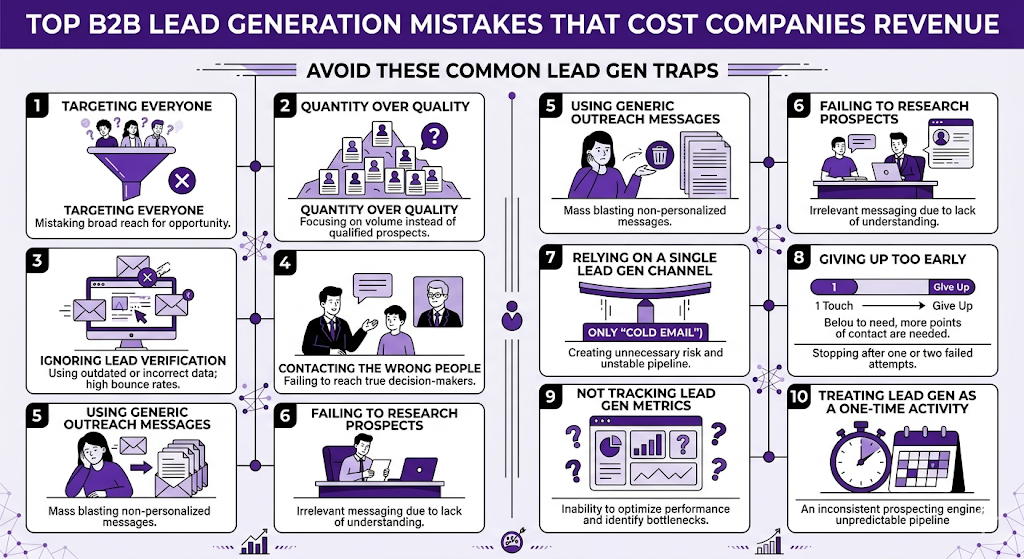
Why Lead Generation Mistakes Are Expensive
Lead generation affects every stage of the sales process.
When lead quality is poor:
- Response rates decrease
- Meeting quality suffers
- Sales cycles become longer
- Conversion rates drop
- Revenue growth slows
Even minor issues in prospecting and qualification can create major problems downstream.
That's why successful businesses focus on improving lead quality before increasing lead volume.
Mistake #1: Targeting Everyone Instead of an Ideal Customer Profile (ICP)
One of the most common mistakes is trying to sell to everyone.
Many businesses believe a larger audience will create more opportunities.
In reality, broad targeting often produces:
- Unqualified leads
- Low engagement
- Poor conversion rates
The Better Approach
Define a clear Ideal Customer Profile (ICP) based on:
- Industry
- Company size
- Geographic location
- Revenue range
- Business challenges
Companies that focus on ICP-based lead generation consistently generate higher-quality opportunities. See our ICP identification guide.
Mistake #2: Prioritizing Lead Quantity Over Lead Quality
A list of 10,000 contacts may look impressive.
However, if most contacts are poor-fit prospects, the list provides little value.
Many sales teams become obsessed with:
- Number of leads
- Number of emails sent
- Number of contacts added
Instead of focusing on:
- Lead quality
- Decision-maker access
- Conversion potential
The Better Approach
Generate fewer but better-qualified leads.
A smaller list of verified prospects often outperforms a massive list of unqualified contacts. Read our guide on finding qualified B2B leads.
Mistake #3: Ignoring Lead Verification
Bad data is one of the biggest causes of outreach failure.
Common data issues include:
- Invalid email addresses
- Outdated job titles
- Incorrect company information
- Duplicate records
These problems lead to:
- High bounce rates
- Poor deliverability
- Wasted prospecting efforts
The Better Approach
Verify lead information before outreach begins.
Accurate data improves campaign performance and protects your sender reputation. Learn how in our lead verification guide.
Mistake #4: Contacting the Wrong People
Many outreach campaigns fail because businesses target individuals who cannot make purchasing decisions.
For example:
A marketing agency may contact a junior marketing executive when the actual buyer is the Founder or Marketing Director.
The Better Approach
Focus on decision makers such as:
- Founders
- CEOs
- Managing Directors
- Sales Directors
- Marketing Directors
- Operations Leaders
The right contact dramatically improves conversion potential. See how to find B2B decision makers.
Mistake #5: Using Generic Outreach Messages
Modern buyers receive countless sales emails every week.
Generic messages such as:
"Would you like to learn more about our services?"
rarely generate meaningful engagement.
The Better Approach
Personalize outreach based on:
- Industry challenges
- Company goals
- Recent business activity
- Specific pain points
Relevant messaging creates stronger conversations.
Mistake #6: Failing to Research Prospects
Prospecting without research often results in irrelevant communication.
Businesses frequently contact companies without understanding:
- Their market
- Their challenges
- Their goals
- Their growth stage
The Better Approach
Spend time understanding each prospect before outreach.
Even basic research can significantly improve response rates.
Mistake #7: Relying on a Single Lead Generation Channel
Many businesses depend entirely on one channel.
Examples include:
- Only cold email
- Only LinkedIn
- Only referrals
- Only paid advertising
This creates unnecessary risk.
The Better Approach
Use multiple channels, including:
- Cold email
- LinkedIn prospecting
- SEO
- Content marketing
- Referrals
- Strategic partnerships
Diversification improves pipeline stability. See our B2B sales prospecting guide.
Mistake #8: Giving Up Too Early
One of the biggest mistakes in sales prospecting is failing to follow up.
Many businesses stop after:
- One email
- One LinkedIn message
- One phone call
However, many prospects require multiple touchpoints before responding.
The Better Approach
Create a structured follow-up process.
Consistent follow-up often generates opportunities that would otherwise be lost.
Mistake #9: Not Tracking Lead Generation Metrics
Without measurement, improvement becomes difficult.
Businesses often fail to track:
- Response rates
- Meeting booking rates
- Opportunity rates
- Close rates
- Customer acquisition costs
The Better Approach
Monitor performance regularly and optimize based on real data.
Metrics help identify bottlenecks and improve decision-making. Learn more in our guide on building a predictable B2B sales pipeline.
Mistake #10: Treating Lead Generation as a One-Time Activity
Some businesses only prospect when sales slow down.
This creates an inconsistent pipeline.
As a result:
- Revenue becomes unpredictable
- Opportunities fluctuate
- Growth stalls
The Better Approach
Lead generation should be a continuous process.
Consistent prospecting creates a healthier pipeline and more reliable revenue growth.
Signs Your Lead Generation Strategy Needs Improvement
Your process may need attention if you experience:
- Low response rates
- High email bounce rates
- Poor meeting quality
- Long sales cycles
- Low conversion rates
- Unpredictable pipeline performance
These symptoms often indicate underlying prospecting or qualification problems.
How Successful B2B Companies Generate Better Leads
High-performing sales teams typically follow a structured approach:
- Define ICP
- Source Qualified Prospects
- Verify Contact Information
- Identify Decision Makers
- Personalize Outreach
- Follow Up Consistently
- Track Results
- Optimize Performance
This process helps create predictable and scalable growth.
Frequently Asked Questions
What is the biggest B2B lead generation mistake?
Targeting the wrong audience is one of the most costly mistakes because it affects every stage of the sales process.
Why is lead verification important?
Lead verification improves data accuracy, reduces bounce rates, and increases outreach effectiveness.
Should businesses focus on lead quality or quantity?
Lead quality should always take priority. Qualified leads convert at significantly higher rates.
How can I improve lead generation results?
Focus on ICP targeting, verified data, decision-maker identification, personalized outreach, and consistent follow-up.
Why do outreach campaigns fail?
Most campaigns fail due to poor targeting, inaccurate data, generic messaging, or insufficient follow-up.
Conclusion
Successful B2B lead generation is not about generating the largest number of contacts. It's about identifying the right companies, reaching the right people, and creating meaningful conversations.
Businesses that avoid common mistakes such as poor targeting, unverified data, generic outreach, and inconsistent prospecting are far more likely to generate qualified leads and predictable revenue growth.
The companies that win in B2B sales are not necessarily the ones doing the most outreach—they are the ones doing the smartest outreach. When you're ready to fix these mistakes at the source, get started with Adsaga.ai or explore more on the Adsaga blog.