
Introduction
Finding potential prospects is only the first step in B2B lead generation. Before sending cold emails, LinkedIn messages, or making sales calls, businesses must ensure their lead data is accurate and up to date.
Many outreach campaigns fail not because the offer is bad, but because the data is wrong. Invalid email addresses, outdated job titles, incorrect company information, and non-decision-maker contacts can significantly reduce campaign performance.
This is where lead verification and learning to verify B2B leads becomes essential.
Lead verification helps businesses confirm that prospects are real, relevant, and reachable before investing time and resources into outreach. In this guide, you'll learn how to improve lead quality, reduce email verification failures, identify decision makers, and strengthen sales pipeline management through better CRM data quality.
Related guides: What Is B2B Lead Generation? A Complete Guide for 2026, How to Identify Your Ideal Customer Profile (ICP) for Better Lead Generation, How to Find Qualified B2B Leads That Actually Convert, How to Find Decision Makers for B2B Sales and Lead Generation, and How to Build a Predictable B2B Sales Pipeline in 2026.
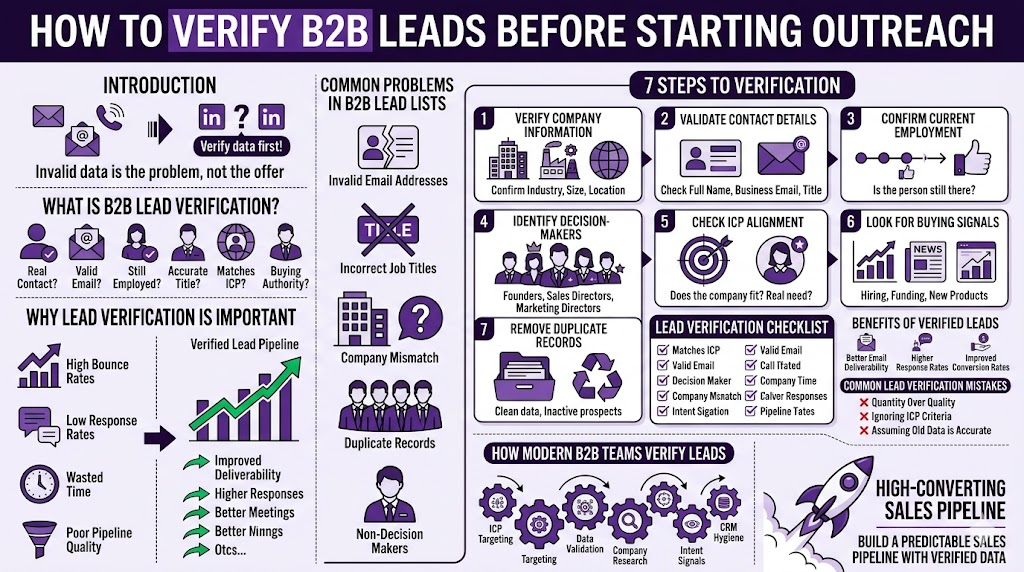
What Is B2B Lead Verification?
B2B lead verification is the process of validating prospect information before initiating sales outreach.
The goal is to confirm that:
- The contact exists
- The email address is valid
- The person still works at the company
- The job title is accurate
- The company matches your Ideal Customer Profile (ICP)
- The prospect has potential buying authority
Verification helps eliminate low-quality data and ensures outreach efforts are focused on qualified opportunities.
Why Lead Verification Is Important
Many businesses underestimate the impact of bad data.
Studies across the sales industry consistently show that business data becomes outdated quickly due to employee turnover, company changes, and organizational restructuring.
Without verification, sales teams often experience:
High Email Bounce Rates
Invalid email addresses damage sender reputation and reduce email deliverability.
Low Response Rates
Prospects who are not relevant to your offer are unlikely to engage.
Wasted Sales Time
Sales representatives spend valuable time contacting people who cannot buy.
Poor Pipeline Quality
Bad data creates inaccurate forecasting and weak sales opportunities.
Lead verification helps prevent these issues before they affect performance.
Common Problems Found in B2B Lead Lists
Even purchased or exported lead lists can contain errors.
Common issues include:
Invalid Email Addresses
Employees change jobs frequently, making email data outdated.
Incorrect Job Titles
A contact who was previously a Marketing Director may now hold a different position.
Company Mismatch
The company may no longer fit your target audience.
Duplicate Records
Duplicate entries clutter CRMs and create reporting inaccuracies.
Non-Decision Makers
The contact may not have purchasing authority.
Identifying these issues early improves outreach effectiveness.
Step 1: Verify Company Information
Start by confirming that the company itself matches your target audience.
Review factors such as:
Industry
Does the company operate within your target market?
Company Size
Does the business fit your ideal employee count or revenue range?
Geographic Location
Is the company located in your target regions?
Business Model
Does the organization align with your service offering?
A prospect may have valid contact information but still be a poor fit if the company doesn't match your ICP.
Step 2: Verify Contact Information
Next, verify the accuracy of individual contact details.
Check:
- Full name
- Business email address
- Job title
- Company affiliation
- Professional profile
Accurate contact information improves outreach success and prevents wasted effort.
Step 3: Confirm the Contact Still Works There
One of the most common problems in B2B databases is employee turnover.
Before outreach, verify:
- The person remains employed at the company
- Their role has not changed significantly
- They are still responsible for relevant business functions
A valid email address is not enough if the person is no longer involved in purchasing decisions.
Step 4: Verify Decision-Making Authority
Not every contact can approve a purchase.
Prioritize individuals with influence over buying decisions.
Common decision-makers include:
Founders and CEOs
Often involved in strategic business decisions.
Sales Directors
Responsible for pipeline growth and revenue generation.
Marketing Directors
Focused on lead generation and customer acquisition.
Operations Managers
Interested in process improvements and efficiency.
Reaching decision-makers improves conversion rates and shortens sales cycles.
Step 5: Check ICP Alignment
A verified lead should also match your Ideal Customer Profile.
Ask:
- Does the company fit our target industry?
- Does the company fit our preferred size range?
- Does the prospect face challenges our solution solves?
- Is there a realistic business need?
ICP verification helps prioritize high-potential opportunities.
Step 6: Look for Buying Signals
Some prospects are more likely to purchase because they show signs of active growth or change.
Common buying signals include:
Hiring Activity
Companies expanding teams often invest in new tools and services.
Funding Announcements
Recently funded businesses may have larger growth budgets.
Product Launches
New initiatives often create demand for additional support.
Market Expansion
Businesses entering new markets frequently need scalable solutions.
Buying signals help identify leads that may be ready to engage.
Step 7: Remove Duplicate and Outdated Records
Clean data improves CRM performance and sales efficiency.
Regularly remove:
- Duplicate contacts
- Inactive prospects
- Invalid companies
- Outdated records
A clean database makes reporting and forecasting more reliable.
Lead Verification Checklist
Before outreach, confirm:
- Company matches ICP
- Contact information is accurate
- Email address is valid
- Job title is current
- Prospect still works at the company
- Contact has decision-making authority
- Company shows potential buying interest
- Record is not duplicated
Completing this checklist significantly improves lead quality.
Benefits of Verified B2B Leads
Businesses that verify leads before outreach often experience:
Better Email Deliverability
Fewer bounces improve sender reputation.
Higher Response Rates
Relevant prospects are more likely to engage.
Better Meeting Quality
Sales conversations occur with qualified decision-makers.
Improved Conversion Rates
Qualified leads create stronger opportunities.
More Predictable Revenue
Higher-quality pipelines support better forecasting. See our guide on building a predictable B2B sales pipeline.
Lead verification directly impacts sales performance.
Common Lead Verification Mistakes
Prioritizing Quantity Over Quality
A smaller list of verified leads often outperforms a large list of unverified contacts.
Ignoring ICP Criteria
Valid contacts can still be poor prospects if they don't fit your target audience.
Assuming Old Data Is Accurate
Business information changes constantly.
Contacting Every Prospect Equally
Prioritize leads based on fit and intent signals.
Skipping CRM Maintenance
Dirty data reduces overall pipeline quality.
How Modern B2B Teams Verify Leads
Leading sales organizations typically combine:
- ICP-based targeting
- Data validation
- Company research
- Decision-maker identification
- Intent signal analysis
- CRM hygiene practices
This approach helps create a pipeline filled with qualified leads rather than random contacts. Adsaga.ai delivers verified B2B leads with ICP-fit sourcing built in—so your team improves sales prospecting efficiency and starts every campaign with trustworthy data.
Frequently Asked Questions
What is lead verification?
Lead verification is the process of confirming the accuracy and relevance of prospect information before sales outreach begins.
Why is lead verification important?
Lead verification improves outreach performance, reduces bounce rates, and increases the likelihood of reaching qualified decision-makers.
How often should lead data be verified?
Lead data should be reviewed regularly because contact information and company details change frequently.
What should be verified before outreach?
Businesses should verify company fit, contact information, job titles, email addresses, and decision-making authority.
Do verified leads convert better?
Yes. Verified leads are generally more accurate, relevant, and likely to engage with outreach efforts.
Conclusion
Lead generation is only effective when the underlying data is accurate. Without verification, businesses risk wasting time, damaging email deliverability, and filling their pipelines with low-quality opportunities.
By verifying company fit, validating contact information, confirming decision-makers, and identifying buying signals, sales teams can dramatically improve outreach performance.
The most successful B2B organizations understand that lead verification is not an optional step—it's a critical part of building a predictable, high-converting sales pipeline. Share your link with Adsaga.ai for ICP-matched, verified leads weekly—or explore more on the Adsaga blog, including common lead generation mistakes to avoid.