
Introduction
One of the biggest challenges in B2B sales is not finding companies—it's finding the right people within those companies.
Many sales teams spend weeks generating leads, building prospect lists, and launching outreach campaigns, only to discover they're speaking with individuals who cannot approve purchases or influence buying decisions.
Even the best product or service becomes difficult to sell when outreach targets the wrong contacts.
That's why learning to find decision makers is one of the most important parts of successful B2B lead generation and B2B sales.
In this guide, you'll learn who decision makers are, why they matter, and how to find the right people to improve sales prospecting, B2B outreach, and your sales pipeline. Pair this with our B2B sales prospecting guide for a complete business development strategy.
Related guides: What Is B2B Lead Generation? A Complete Guide for 2026, How to Identify Your Ideal Customer Profile (ICP) for Better Lead Generation, How to Find Qualified B2B Leads That Actually Convert, How to Verify B2B Leads Before Starting Outreach, and How to Build a Predictable B2B Sales Pipeline in 2026.
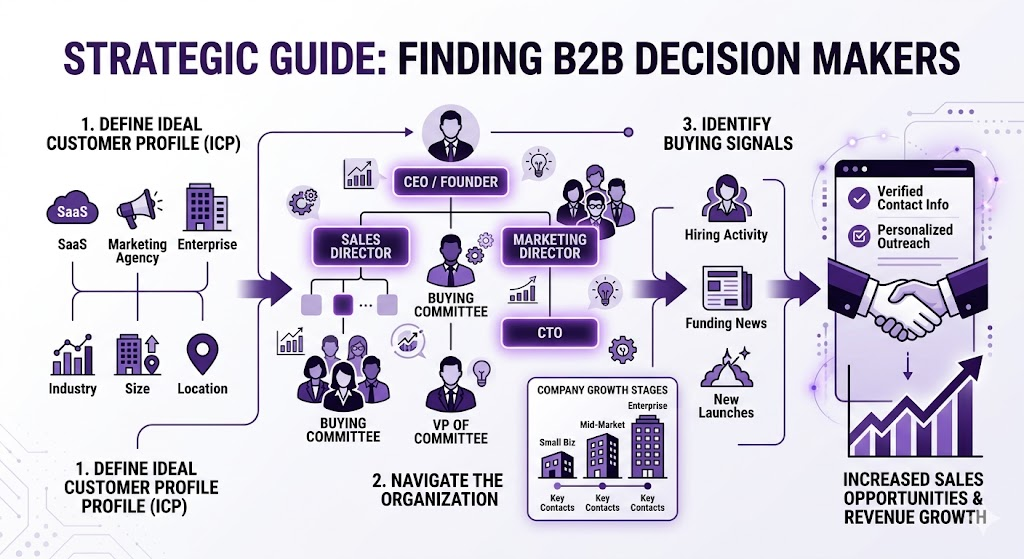
What Is a Decision Maker?
A decision maker is a person within an organization who has the authority to approve, influence, or participate in purchasing decisions.
Depending on the company and purchase size, decision makers may include:
- Founder
- CEO
- Managing Director
- Sales Director
- Marketing Director
- Operations Manager
- Chief Technology Officer (CTO)
- Procurement Manager
The larger the company, the more people are typically involved in the buying process.
Why Finding Decision Makers Matters
Many businesses make the mistake of reaching out to anyone whose contact information they can find.
This often leads to:
Lower Response Rates
People who cannot make decisions are less likely to engage.
Longer Sales Cycles
Information must be passed through multiple layers of management.
Poor Meeting Quality
Conversations occur with individuals who lack buying authority.
Wasted Prospecting Effort
Sales teams spend time nurturing contacts who cannot move deals forward.
Finding the right decision maker significantly improves outreach efficiency.
Understanding the B2B Buying Committee
Modern B2B purchases often involve multiple stakeholders.
For example, when selling lead generation services, the buying committee may include:
CEO or Founder
Responsible for business growth and strategic investments.
Sales Director
Focused on pipeline development and revenue generation.
Marketing Director
Interested in lead quality and customer acquisition.
Operations Manager
Evaluates efficiency and process improvements.
Finance Team
Reviews budgets and financial impact.
Understanding who influences purchasing decisions helps target outreach more effectively.
Step 1: Define Your Ideal Customer Profile (ICP)
Before searching for decision makers, identify the right companies.
Your ICP should define:
Industry
Examples:
- SaaS Companies
- Marketing Agencies
- IT Services
- Recruitment Firms
- Consulting Businesses
Company Size
- Small Businesses
- Mid-Market Companies
- Enterprise Organizations
Geographic Location
- United States
- United Kingdom
- Canada
- Australia
- Europe
Once you've identified target companies, finding decision makers becomes much easier.
Step 2: Identify the Department That Benefits Most
Different products solve different business problems.
Ask yourself: "Which department receives the most value from our solution?"
Examples:
Lead Generation Services
Potential decision makers:
- Founder
- CEO
- Sales Director
- Business Development Manager
Marketing Software
Potential decision makers:
- Marketing Director
- Demand Generation Manager
- Growth Manager
IT Services
Potential decision makers:
- CTO
- IT Manager
- Operations Director
The person experiencing the problem is often involved in the purchasing decision.
Step 3: Prioritize Senior-Level Contacts
In B2B sales, senior decision makers typically have greater purchasing authority.
Common titles include:
Founder
Often involved in strategic business decisions.
CEO
Responsible for company growth and investments.
Managing Director
Oversees overall business performance.
Vice President
Leads specific departments and budgets.
Director
Often controls purchasing decisions within their department.
Senior-level contacts generally provide faster decision-making and clearer business discussions.
Step 4: Understand the Company's Growth Stage
Decision-making structures vary depending on company size.
Small Businesses
Decision makers are often:
- Founder
- CEO
- Owner
Mid-Market Companies
Decision makers may include:
- Department Directors
- Vice Presidents
- Operations Leaders
Enterprise Organizations
Purchasing decisions often involve:
- Multiple stakeholders
- Procurement teams
- Department heads
- Executive leadership
Understanding company size helps identify the correct contact more efficiently.
Step 5: Look for Buying Signals
Not every decision maker is ready to buy.
Focus on companies showing signs of growth or change.
Examples include:
Hiring Activity
Companies expanding their teams often invest in growth solutions.
Funding Announcements
Recently funded businesses may have larger budgets.
New Product Launches
Growth initiatives frequently create demand for additional services.
Market Expansion
Businesses entering new regions often need scalable systems and support.
Buying signals help prioritize opportunities.
Step 6: Verify Contact Information
Before outreach, verify:
- Full name
- Job title
- Company affiliation
- Business email address
- Current employment status
Accurate data improves response rates and prevents wasted effort. See our guide on how to verify B2B leads before outreach.
Step 7: Personalize Outreach to Decision Makers
Decision makers receive countless sales messages every week.
Generic outreach often gets ignored.
Instead, reference:
Business Challenges
Show that you understand their industry.
Company Goals
Connect your solution to growth objectives.
Relevant Pain Points
Focus on problems your solution can solve.
Potential Outcomes
Highlight measurable results.
Personalized outreach consistently performs better than mass messaging.
Common Decision-Maker Titles by Industry
SaaS Companies
- Founder
- CEO
- CRO
- VP of Sales
- VP of Marketing
Marketing Agencies
- Founder
- Managing Director
- Growth Director
- Business Development Manager
IT Service Providers
- CEO
- CTO
- Operations Director
- Technology Manager
Recruitment Agencies
- Founder
- Managing Director
- Business Development Director
Knowing common titles helps streamline prospecting efforts.
Common Mistakes to Avoid
Targeting Junior Employees
Many junior contacts cannot influence purchasing decisions.
Ignoring Buying Committees
Large purchases often require approval from multiple stakeholders.
Focusing Only on Job Titles
A title alone does not guarantee buying authority.
Skipping Lead Verification
Outdated information creates poor outreach results.
Sending Generic Messages
Decision makers respond better to relevant, personalized communication.
Benefits of Reaching the Right Decision Makers
Businesses that target decision makers effectively often experience:
Higher Response Rates
Relevant contacts are more likely to engage.
Better Meetings
Conversations occur with people who understand business priorities.
Faster Sales Cycles
Fewer internal approvals are required.
Improved Conversion Rates
Qualified decision makers create stronger opportunities.
More Predictable Revenue Growth
High-quality prospecting produces more consistent pipeline results.
Adsaga.ai accelerates this with ICP-based lead sourcing and verified decision-maker contacts—so your team spends less time on manual research and more time on conversations that move deals forward.
Frequently Asked Questions
Who is considered a decision maker in B2B sales?
A decision maker is someone with the authority or influence to approve business purchases and investments.
Why is it important to target decision makers?
Decision makers can move opportunities forward, reducing delays and improving conversion rates.
How do I identify decision makers within a company?
Focus on company size, department relevance, seniority level, and purchasing responsibility.
Are CEOs always the best contacts?
Not always. Depending on the solution, department leaders or directors may have more direct responsibility for purchasing decisions.
Should I contact multiple stakeholders?
Yes. Many B2B purchases involve multiple decision makers and influencers.
Conclusion
Successful B2B lead generation is not simply about finding companies—it's about finding the right people within those companies.
By defining your Ideal Customer Profile, understanding organizational structures, identifying buying signals, and targeting senior decision makers, businesses can dramatically improve outreach performance and sales results.
The most successful sales teams don't just generate leads. They connect with the people who have the authority to turn opportunities into revenue. Share your link with Adsaga.ai to receive ICP-matched, verified decision-makers weekly—or explore more on the Adsaga blog, including lead generation mistakes to avoid.