
Introduction
One of the biggest reasons B2B lead generation campaigns fail is targeting the wrong audience. Many businesses spend time and money generating leads, only to discover that most prospects are not a good fit for their product or service.
This is where an Ideal Customer Profile (ICP) becomes essential.
An ICP helps businesses focus their lead sourcing efforts on companies that are most likely to become customers. Instead of chasing thousands of random contacts, sales and marketing teams can prioritize high-value prospects that match their target audience.
In this guide, you'll learn how to identify your Ideal Customer Profile (ICP) for better lead generation in 2026—covering ICP lead generation, lead qualification, sales prospecting, and a customer profile strategy that fuels a predictable B2B sales pipeline with qualified leads.
For deeper process context, see our B2B Sales Prospecting Guide (2026) and Top B2B Lead Generation Mistakes That Cost Companies Revenue.
Related guides: What Is B2B Lead Generation? A Complete Guide for 2026, ICP-Based Lead Generation vs Bulk Lists, How to Find Qualified B2B Leads That Actually Convert, How to Verify B2B Leads Before Starting Outreach, and How to Find Decision Makers for B2B Sales and Lead Generation.
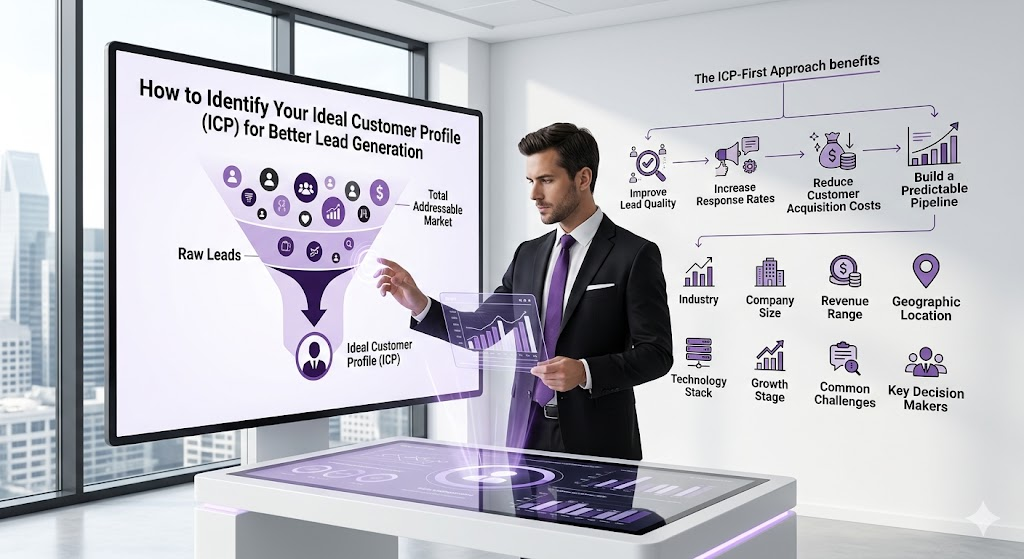
What Is an Ideal Customer Profile (ICP)?
An Ideal Customer Profile (ICP) is a detailed description of the type of company that is most likely to benefit from your product or service and become a successful long-term customer.
An ICP focuses on the company itself rather than an individual buyer.
A strong ICP typically includes:
- Industry
- Company size
- Revenue range
- Geographic location
- Business model
- Technology stack
- Growth stage
- Common challenges
By defining these characteristics, businesses can focus on generating qualified leads instead of wasting resources on poor-fit prospects.
Why Is ICP Important for B2B Lead Generation?
Without an ICP, lead generation often becomes a numbers game.
Businesses purchase large contact lists, send generic outreach messages, and hope for positive responses. This approach usually leads to low conversion rates and wasted sales efforts.
An ICP-first approach helps:
Improve Lead Quality
Your sales team spends more time speaking with companies that actually need your solution.
Increase Response Rates
Prospects are more likely to engage when your offer is relevant to their business.
Reduce Customer Acquisition Costs
Targeting the right audience reduces wasted marketing and sales spend.
Build a Predictable Sales Pipeline
Consistent targeting creates a more reliable flow of qualified opportunities. Learn how to operationalize this in our guide on building a predictable B2B sales pipeline.
Increase Revenue Growth
Higher-quality leads often result in better conversion rates and larger deals.
ICP vs Buyer Persona: What's the Difference?
Many businesses confuse an Ideal Customer Profile with a Buyer Persona.
Ideal Customer Profile (ICP)
Defines the company.
Examples:
- SaaS companies
- Marketing agencies
- IT service providers
- Manufacturing companies
Focuses on:
- Industry
- Company size
- Revenue
- Location
- Business characteristics
Buyer Persona
Defines the individual decision-maker.
Examples:
- CEO
- Founder
- Marketing Director
- Sales Manager
- Operations Head
Focuses on:
- Job role
- Responsibilities
- Goals
- Pain points
- Buying behavior
Your ICP tells you which companies to target, while your buyer persona tells you who to contact within those companies.
Step 1: Analyze Your Best Existing Customers
The easiest way to identify your ICP is by studying your current customers.
Ask yourself:
- Which customers generate the most revenue?
- Which customers stay the longest?
- Which customers require the least support?
- Which customers see the best results?
Look for common patterns.
For example, if most successful customers are SaaS companies with 10–100 employees, that may indicate a strong ICP segment.
Your best customers often provide the blueprint for future lead generation efforts.
Step 2: Identify Industry Fit
Certain industries are naturally a better fit for specific solutions.
For example:
Lead Generation Services
Ideal industries may include:
- Marketing agencies
- SaaS companies
- IT consulting firms
- Recruitment agencies
- Business service providers
CRM Software
Ideal industries may include:
- Sales organizations
- Customer support teams
- Service-based businesses
The more specific your industry targeting, the easier it becomes to generate qualified leads.
Step 3: Define Company Size
Company size plays a major role in determining whether a prospect is a good fit.
Consider factors such as:
- Number of employees
- Annual revenue
- Team size
- Market maturity
For example:
Small Businesses
- 1–50 employees
Mid-Market Companies
- 51–500 employees
Enterprise Organizations
- 500+ employees
Each segment has different budgets, needs, and buying processes.
Step 4: Determine Geographic Targeting
Location can significantly impact sales success.
Ask:
- Which countries generate the best customers?
- Which regions have the highest demand?
- Which markets are easiest to serve?
Examples:
- United States
- Canada
- United Kingdom
- Australia
- Europe
- India
Geographic targeting helps improve lead quality and outreach relevance.
Step 5: Identify Common Pain Points
The best ICPs share similar challenges.
Examples include:
Marketing Agencies
- Need a steady flow of qualified leads
- Struggle with manual prospecting
- Need scalable lead generation systems
SaaS Companies
- Need faster customer acquisition
- Require pipeline growth
- Want better sales efficiency
IT Service Providers
- Need consistent opportunities
- Want access to decision-makers
- Need predictable revenue growth
Understanding these pain points helps create more effective outreach campaigns.
Step 6: Identify Key Decision Makers
Once you've identified the right companies, determine who makes purchasing decisions.
Common B2B decision-makers include:
- Founder
- CEO
- Managing Director
- Marketing Director
- Sales Director
- Operations Manager
- Business Development Manager
Targeting decision-makers improves response rates and shortens sales cycles.
Step 7: Evaluate Technology and Business Signals
Modern lead generation teams often use additional qualification criteria.
Examples include:
Technology Stack
Which tools does the company currently use?
Hiring Activity
Are they actively expanding?
Funding Events
Have they recently raised capital?
Growth Signals
Are they entering new markets?
These indicators often reveal buying intent and improve lead quality.
Example of an Ideal Customer Profile
Let's consider a lead generation company.
Industry Marketing Agencies, SaaS Companies, IT Services
Employee Count 10–200 Employees
Location United States, United Kingdom, Canada, Australia
Decision Makers Founders, CEOs, Marketing Directors, Sales Directors
Pain Points Lack of qualified leads; inconsistent sales pipeline; time-consuming prospecting; poor lead quality
Goals Generate more meetings; increase revenue; improve sales efficiency
This level of detail helps focus lead generation efforts on the most promising prospects.
Common ICP Mistakes to Avoid
Targeting Everyone
If everyone is your customer, nobody is your customer.
Focusing Only on Company Size
Industry, pain points, and buying behavior are equally important.
Ignoring Existing Customer Data
Your current customers often provide the best insights.
Never Updating Your ICP
Markets change. Review and refine your ICP regularly.
Prioritizing Quantity Over Quality
Generating thousands of unqualified leads rarely produces sustainable growth.
How ICP Improves Lead Generation Results
Businesses that use ICP-based lead generation often experience:
- Higher response rates
- Better meeting quality
- Improved conversion rates
- Reduced prospecting costs
- More predictable sales pipelines
- Increased customer lifetime value
An accurate ICP helps sales and marketing teams focus on opportunities that are most likely to convert. Adsaga.ai turns your Ideal Customer Profile (ICP) into weekly, verified qualified leads with decision makers built in—so your team improves lead sourcing and spends time on conversations that grow your B2B sales pipeline.
Frequently Asked Questions
What is an Ideal Customer Profile (ICP)?
An Ideal Customer Profile is a description of the type of company most likely to become a successful customer based on industry, size, location, revenue, and business needs.
Why is ICP important in lead generation?
ICP helps businesses target high-quality prospects, improve conversion rates, and reduce wasted sales efforts.
How often should I update my ICP?
Most businesses should review their ICP every 6–12 months or whenever significant market changes occur.
What is the difference between an ICP and a buyer persona?
An ICP describes the company, while a buyer persona describes the individual decision-maker within that company.
Can small businesses benefit from ICP-based lead generation?
Yes. Businesses of all sizes can improve lead quality and sales performance by focusing on ideal customers.
Conclusion
Identifying your Ideal Customer Profile is one of the most important steps in building a successful B2B lead generation strategy.
Instead of targeting every company in the market, businesses should focus on organizations that closely match their best customers. By defining industry, company size, location, decision-makers, and pain points, sales teams can generate higher-quality leads and create a more predictable pipeline.
The most successful B2B companies don't generate the most leads—they generate the right leads. A well-defined ICP ensures every prospecting effort moves your business closer to qualified opportunities, better meetings, and sustainable growth. Share your ICP with Adsaga.ai for ICP-matched, verified leads weekly—or explore more on the Adsaga blog, including how to find qualified B2B leads and common lead generation mistakes to avoid.