
Introduction
No matter how good your product or service is, growth becomes difficult without a consistent flow of qualified prospects.
This is where B2B sales prospecting plays a critical role.
Sales prospecting is the process of identifying, researching, and engaging potential customers before they enter your sales pipeline. For agencies and SaaS companies, effective prospecting creates a predictable stream of meetings, opportunities, and revenue.
However, many businesses struggle because they target the wrong companies, contact the wrong people, or rely on outdated prospecting methods. Avoid common pitfalls covered in our guide on Top B2B Lead Generation Mistakes That Cost Companies Revenue.
In this guide, you'll learn a proven step-by-step B2B sales prospecting process for agency lead generation and SaaS lead generation—covering qualified leads, decision makers, lead verification, and sales pipeline strategy.
Build your foundation with these related guides: What Is B2B Lead Generation? A Complete Guide for 2026, How to Identify Your Ideal Customer Profile (ICP) for Better Lead Generation, How to Find Qualified B2B Leads That Actually Convert, How to Verify B2B Leads Before Starting Outreach, and How to Build a Predictable B2B Sales Pipeline in 2026.
What Is B2B Sales Prospecting?
B2B sales prospecting is the process of finding potential business customers and initiating conversations with them.
The objective is simple:
- Identify companies that fit your target audience
- Find decision makers
- Start meaningful conversations
- Generate sales opportunities
Unlike lead generation, which focuses on attracting prospects, prospecting involves actively searching for and engaging potential buyers.
Why Sales Prospecting Is Important
Without prospecting, sales pipelines eventually dry up.
Consistent prospecting helps businesses:
- Generate qualified leads
- Increase sales opportunities
- Improve revenue predictability
- Reduce dependency on referrals
- Build long-term growth
The most successful agencies and SaaS companies treat prospecting as an ongoing process rather than a one-time activity.
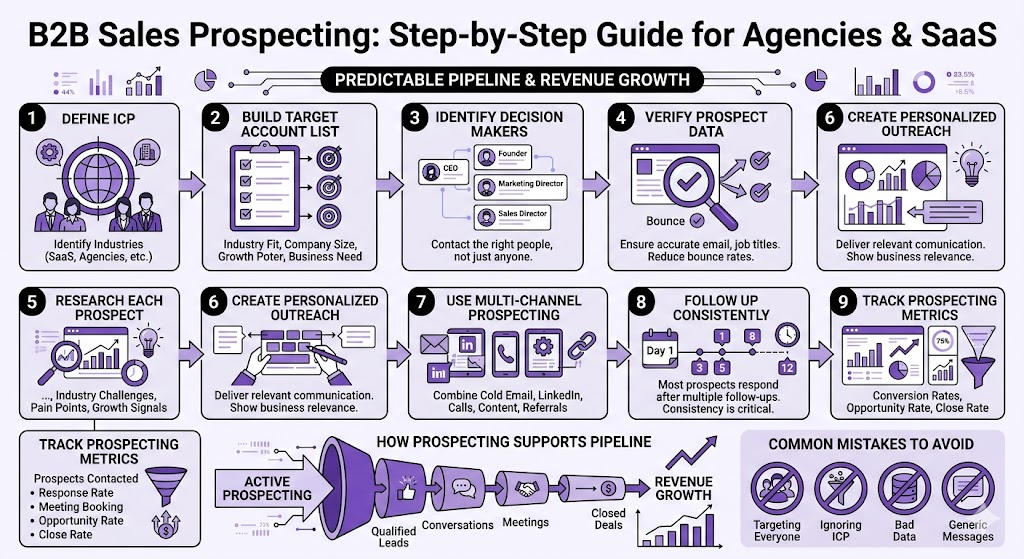
Step 1: Define Your Ideal Customer Profile (ICP)
Every successful prospecting campaign starts with a clear Ideal Customer Profile.
Ask yourself:
Which industries benefit most from our solution?
Examples:
- SaaS Companies
- Marketing Agencies
- IT Service Providers
- Recruitment Firms
- Consulting Businesses
What company size is ideal?
- 10–50 employees
- 50–200 employees
- 200–1000 employees
Which locations should we target?
- United States
- Canada
- United Kingdom
- Australia
- Europe
The clearer your ICP, the easier it becomes to identify qualified prospects. Use our ICP identification guide for a detailed framework.
Step 2: Build a Target Account List
Once your ICP is defined, create a list of companies that match your criteria.
Focus on:
Industry Fit
Do they operate in your target market?
Company Size
Do they fit your ideal customer range?
Growth Potential
Are they actively expanding?
Business Need
Can your solution solve a meaningful problem?
A targeted account list improves efficiency and lead quality.
Step 3: Identify Decision Makers
Finding the right company is only half the process.
You also need to reach the right people.
Common decision makers include:
Founder
Often responsible for strategic growth decisions.
CEO
Focuses on company performance and revenue.
Marketing Director
Interested in customer acquisition and growth.
Sales Director
Focused on pipeline generation and revenue targets.
Operations Manager
Looks for efficiency and business improvements.
Targeting decision makers improves response rates and shortens sales cycles. See our guide on how to find B2B decision makers.
Step 4: Verify Prospect Data
Before launching outreach, verify every lead.
Check:
- Company information
- Contact details
- Email accuracy
- Job titles
- Current employment status
Lead verification helps:
- Reduce bounce rates
- Improve deliverability
- Increase response rates
- Improve meeting quality
High-quality data is the foundation of successful prospecting. Learn more in our lead verification guide.
Step 5: Research Each Prospect
Modern buyers expect relevant communication.
Before outreach, understand:
Company Goals
What is the business trying to achieve?
Industry Challenges
What problems are common in their market?
Growth Signals
Are they hiring, expanding, or launching new initiatives?
Potential Pain Points
How can your solution help?
Research creates opportunities for personalized conversations.
Step 6: Create Personalized Outreach
Generic sales messages rarely succeed.
Effective outreach should demonstrate relevance.
Instead of:
"We help businesses grow. Interested?"
Try:
"I noticed your agency is expanding its sales team. We help agencies generate verified B2B leads and build predictable sales pipelines."
Specific messages consistently outperform generic templates.
Step 7: Use Multi-Channel Prospecting
Modern prospecting works best across multiple channels.
Cold Email
Scalable and highly effective when personalized.
LinkedIn Outreach
Useful for building relationships and credibility.
Direct Calls
Can accelerate conversations with interested prospects.
Content Marketing
Helps establish expertise and trust.
Referral Networks
Often produce highly qualified opportunities.
Multi-channel engagement increases visibility and response rates.
Step 8: Follow Up Consistently
Many sales opportunities are lost because teams stop following up too early.
A typical prospecting sequence might include:
Day 1
Initial email
Day 3
LinkedIn connection request
Day 5
Follow-up email
Day 8
Value-based message
Day 12
Final follow-up
Most prospects require multiple touchpoints before responding.
Consistency is critical.
Step 9: Track Prospecting Metrics
Successful sales teams monitor performance closely.
Important metrics include:
Prospects Contacted
How many qualified contacts were reached?
Response Rate
How many prospects engaged?
Meeting Booking Rate
How many conversations turned into meetings?
Opportunity Rate
How many meetings became opportunities?
Close Rate
How many opportunities became customers?
Tracking metrics helps identify bottlenecks and optimize performance.
Common Prospecting Mistakes to Avoid
Targeting Everyone
Broad targeting reduces lead quality.
Ignoring ICP Criteria
Poor-fit prospects rarely convert.
Using Unverified Data
Bad data damages outreach performance.
Sending Generic Messages
Personalization improves engagement.
Giving Up Too Early
Many prospects respond after multiple follow-ups.
Focusing Only on Volume
Quality consistently outperforms quantity. See common B2B lead generation mistakes that drain pipeline ROI.
Best Practices for Agencies and SaaS Companies
The highest-performing teams typically:
- Use ICP-based targeting
- Focus on qualified leads
- Verify prospect data
- Personalize outreach
- Follow structured prospecting processes
- Measure performance consistently
These practices create stronger pipelines and more predictable pipeline growth. Adsaga.ai helps agencies and SaaS teams scale prospecting with ICP-based sourcing, verified leads, and decision-maker lists—so reps spend less time on list building and more time on B2B outreach that converts.
How Prospecting Supports Pipeline Growth
A strong sales pipeline starts with effective prospecting.
The process looks like this:
- Define ICP
- Build Target Account List
- Identify Decision Makers
- Verify Data
- Launch Outreach
- Book Meetings
- Create Opportunities
- Close Deals
Each stage contributes to predictable revenue growth.
Frequently Asked Questions
What is B2B sales prospecting?
B2B sales prospecting is the process of identifying and contacting potential business customers to generate sales opportunities.
Why is prospecting important?
Prospecting creates a consistent flow of qualified leads and supports long-term business growth.
What is the difference between prospecting and lead generation?
Lead generation attracts prospects, while prospecting actively identifies and contacts potential buyers.
How do agencies generate qualified prospects?
Agencies typically use ICP targeting, lead verification, personalized outreach, and multi-channel prospecting.
How can SaaS companies improve prospecting results?
By focusing on qualified leads, decision makers, data quality, and consistent follow-up.
Conclusion
B2B sales prospecting is one of the most important activities for agencies and SaaS companies looking to grow consistently.
By defining your Ideal Customer Profile, identifying decision makers, verifying data, personalizing outreach, and maintaining a structured follow-up process, you can generate more qualified opportunities and build a predictable sales pipeline.
The most successful companies don't rely on luck to find customers. They follow a repeatable prospecting process that consistently turns prospects into revenue. Share your link with Adsaga.ai to get ICP-matched, verified prospects delivered weekly—or explore more guides on the Adsaga blog, including lead generation mistakes to avoid in 2026.