
Lead qualification is where B2B sales productivity is won or lost. Every hour spent on a prospect who cannot buy, will not buy, or is not ready to buy is an hour stolen from deals that close. This guide walks through the complete lead qualification process—frameworks, questions, scoring models, and handoff standards that turn raw contacts into sales-qualified opportunities.
Whether you are an SDR qualifying inbound demos, an AE running discovery on outbound targets, or a sales leader designing qualification criteria for your team, a consistent process prevents pipeline inflation and improves forecast accuracy.
You will learn how to define qualification criteria, apply proven frameworks, score leads systematically, run discovery conversations, and hand off SQLs that account executives actually accept.
For related context, see how sales teams find qualified leads, how to find qualified B2B leads, and how AI qualifies B2B leads automatically.
What Is Lead Qualification in B2B Sales?
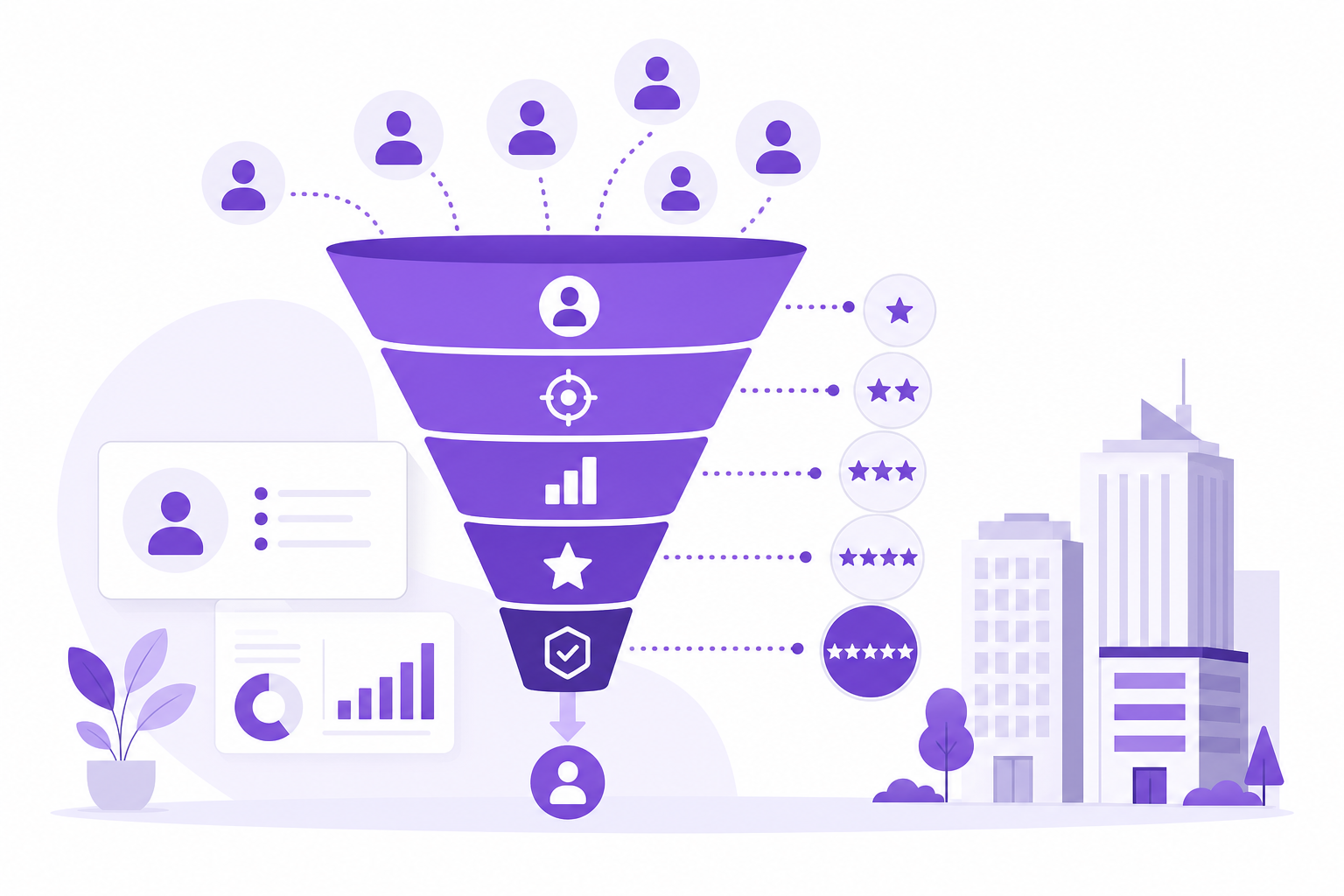
Lead qualification is the process of evaluating whether a prospect is worth active sales investment based on fit, need, authority, and timing. It happens at multiple stages:
- Marketing qualification (MQL): Fit and engagement sufficient for sales follow-up
- Sales qualification (SQL): Confirmed fit, need, and path to opportunity
- Opportunity qualification: Validated deal potential before proposal stage
Without clear stage definitions, marketing and sales argue about lead quality while pipeline numbers look healthy but revenue misses target.
Why a Structured Qualification Process Matters
Ad-hoc qualification produces inconsistent results. One rep accepts any meeting; another rejects everything. Forecasts become unreliable. Account executives resent SDR handoffs lacking context.
A documented qualification process delivers:
- Consistent SQL criteria across the team
- Higher AE acceptance rates on SDR handoffs
- Shorter sales cycles (fewer unqualified discovery calls)
- Cleaner CRM data and accurate pipeline reporting
- Better alignment between marketing, SDR, and AE functions
- Clear feedback loops to improve targeting
Step 1: Define Your Qualification Criteria
Before qualifying individual leads, document what "qualified" means for your business. Criteria should connect directly to your ICP and sales motion.
Firmographic Criteria
- Industry and sub-vertical
- Company size (employees, revenue)
- Geography and market segment
- Technology or operational profile
Define ICP first with how to build an ideal customer profile and ICP identification guide.
Behavioral Criteria
- Content engagement (downloads, webinar attendance)
- Website behavior (pricing page visits, repeat sessions)
- Outreach response (positive reply, meeting acceptance)
- Intent signals (topic research, competitor comparisons)
Disqualification Criteria
Equally important: define who you do not sell to. Document disqualifiers such as company size below minimum, unsupported geography, competitor employees, students, or industries outside compliance scope.
Step 2: Choose a Qualification Framework
Frameworks give reps shared language for discovery conversations. Choose one primary framework and train the team consistently.
BANT (Budget, Authority, Need, Timeline)
Best for transactional and mid-market deals with shorter cycles:
- Budget: Can they afford the solution?
- Authority: Are you speaking with a decision-maker?
- Need: Is there a clear pain your product solves?
- Timeline: Is there urgency to act?
BANT is fast and practical but can feel transactional if applied rigidly without rapport-building.
MEDDIC (Metrics, Economic Buyer, Decision Criteria, Decision Process, Identify Pain, Champion)
Best for enterprise and complex deals:
- Metrics: What measurable outcomes matter?
- Economic buyer: Who controls budget?
- Decision criteria: How will they evaluate options?
- Decision process: What steps lead to purchase?
- Identify pain: What problem drives the initiative?
- Champion: Who internally advocates for your solution?
MEDDIC requires more discovery depth but produces higher-quality enterprise opportunities.
CHAMP (Challenges, Authority, Money, Prioritization)
Lead with pain before budget—useful when prospects resist early budget discussions. Challenges and prioritization reveal whether the problem is urgent enough to fund.
GPCTBA/C&I (Goals, Plans, Challenges, Timeline, Budget, Authority, Consequences and Implications)
HubSpot's expanded framework adds consequences of inaction—powerful for creating urgency when timeline is vague.
Step 3: Implement Lead Scoring
Scoring prioritizes which leads to contact first and which can wait. Combine fit and engagement into a single score.
Fit Score (Demographic/Firmographic)
Points for ICP alignment: right industry (+20), right size (+15), target geography (+10), technographic match (+10). Deduct points for disqualifiers.
Engagement Score (Behavioral)
Points for actions: pricing page visit (+15), demo request (+25), email reply (+10), meeting attended (+20), content download (+5).
Thresholds
- 0–30: Nurture or disqualify
- 31–60: SDR outreach with standard sequence
- 61–80: Priority outreach, senior SDR or AE involvement
- 81+: Immediate action, executive engagement if strategic account
Automate scoring with AI lead qualification and AI ICP tools.
Step 4: Qualify Inbound Leads Quickly
Inbound leads decay fast. Speed-to-lead correlates directly with conversion. A practical inbound qualification workflow:
- Within 5 minutes: Auto-acknowledge and route to SDR
- Within 1 hour: SDR reviews ICP fit and engagement history
- Same day: Qualification call or email with discovery questions
- Within 48 hours: SQL handoff to AE or nurture sequence
Not every inbound lead deserves a call. Filter by ICP fit before investing SDR time on demo requests from wrong-fit companies.
Step 5: Qualify Outbound Prospects Before and During Outreach
Outbound qualification happens in layers:
- Pre-outreach: ICP fit, verified contact, role relevance
- Initial response: Interest level, pain acknowledgment, meeting willingness
- Discovery call: Framework questions (BANT, MEDDIC, etc.)
- SQL confirmation: Documented fit, need, authority, and next step
Build outbound lists using B2B prospecting workflow and sales prospecting guide.
Step 6: Run Effective Qualification Discovery Calls
Discovery is not a pitch—it is structured investigation. A 20–30 minute qualification call structure:
- Opening (2 min): Agenda, permission to ask questions
- Context (5 min): Their role, company situation, what prompted interest
- Pain exploration (10 min): Current challenges, impact, what they have tried
- Qualification (5 min): Decision process, timeline, budget range, stakeholders
- Next step (3 min): Demo, technical review, or honest disqualification
Take notes in CRM in real time. Incomplete notes at handoff force AEs to re-qualify from scratch.
Step 7: Define SQL Criteria and Handoff Standards
Document exactly what makes a lead sales-qualified for your organization. Example SQL criteria:
- Confirmed ICP fit (industry, size, geography)
- Identified pain aligned with your solution
- Spoken with or confirmed access to decision-maker or champion
- Agreed to next step (demo, discovery with AE, technical evaluation)
- Timeline within 6 months (adjust for your sales cycle)
- Budget range discussed or inferred as viable
SQL handoff package should include: contact details, company context, discovery notes, qualification framework answers, objection heard, and recommended AE approach.
Step 8: Handle Disqualification Professionally
Disqualifying leads is productive—not failure. When a prospect does not qualify:
- Explain honestly why it may not be the right fit
- Offer alternative resources if appropriate (partner referral, content)
- Document disqualification reason in CRM
- Set re-engagement trigger if timing was the only issue
- Feed disqualification patterns back to marketing and list building
Protecting AE time from bad leads is one of the highest-value activities an SDR performs.
How AI Supports Lead Qualification
AI augments human qualification at scale:
- Pre-qualifies accounts by ICP fit before outreach
- Scores leads based on firmographic and behavioral data
- Enriches accounts with context for discovery conversations
- Flags high-intent accounts for priority follow-up
- Reduces time SDRs spend on manual research
AI does not replace discovery calls—it ensures reps spend those calls on prospects worth qualifying. See how SDR teams save time with AI and AI workflow for sales teams.
Qualification Metrics to Track
- MQL-to-SQL conversion rate
- SQL acceptance rate by AE
- SQL-to-opportunity conversion rate
- Disqualification rate and top reasons
- Average time from lead to SQL
- Opportunity win rate by lead source
- Pipeline value per qualified lead
Review monthly. Low SQL acceptance means SDR and AE criteria are misaligned. Low SQL-to-opportunity conversion means qualification is too loose.
Common Lead Qualification Mistakes
- Qualifying on interest alone without ICP fit
- Accepting meetings as SQLs without discovery
- No documented disqualification criteria
- Inconsistent frameworks across reps
- Handing off leads without CRM notes
- Ignoring timing—fit without urgency
- Over-qualifying and slowing speed-to-lead
- Under-qualifying to hit activity metrics
Frequently Asked Questions
What is the lead qualification process in B2B sales?
The lead qualification process evaluates prospects against ICP fit, need, authority, and timing using frameworks like BANT or MEDDIC. It includes lead scoring, discovery conversations, SQL criteria definition, and structured handoff to account executives.
What is the difference between MQL and SQL?
An MQL (marketing qualified lead) shows fit and engagement sufficient for sales contact. An SQL (sales qualified lead) has been validated through discovery—confirmed pain, decision-maker access, and agreed next step toward an opportunity.
Which qualification framework should my team use?
Use BANT or CHAMP for shorter, transactional sales cycles. Use MEDDIC for enterprise deals with multiple stakeholders and long evaluation processes. Pick one framework and train consistently rather than mixing approaches.
How does AI improve lead qualification?
AI pre-scores leads by ICP fit and intent signals, enriches account data for discovery, and prioritizes outreach queues—so reps spend qualification time on prospects most likely to convert.
When should you disqualify a B2B lead?
Disqualify when the company is outside ICP, there is no identifiable pain, no access to decision-makers, budget is clearly insufficient, timeline is beyond 12+ months with no nurture path, or the prospect is a competitor or bad-fit persona.
Final Thoughts
Lead qualification is not a gatekeeping exercise—it is a productivity multiplier. Teams that qualify rigorously close more deals with fewer reps because every hour flows toward winnable opportunities.
Document your criteria. Train on one framework. Score before you call. Discover before you hand off. Disqualify without guilt. The qualification process you build today determines pipeline quality for every quarter ahead.
Ready to qualify leads faster and more accurately? Get started with Adsaga.ai or explore more sales guides on the Adsaga blog.
How Adsaga.ai Streamlines Lead Qualification
Adsaga.ai helps B2B sales teams qualify leads before the first call—using AI to score ICP fit, identify decision-makers, and prioritize accounts with the highest conversion potential.
With Adsaga.ai, sales teams can:
- Pre-qualify prospects by industry, size, geography, and product fit
- Score leads automatically based on firmographic alignment
- Identify verified decision-makers before outreach begins
- Reduce time spent qualifying unfit accounts manually
- Improve SDR-to-AE handoff quality with enriched account data
- Build pipeline where every lead has documented ICP justification
Combine the qualification framework in this guide with Adsaga.ai to stop chasing bad leads and start closing qualified opportunities. Try Adsaga.ai and upgrade your lead qualification process in 2026.