
Industrial equipment suppliers play a critical role in manufacturing, construction, logistics, energy, and infrastructure projects. Whether you supply material handling equipment, compressors, pumps, generators, CNC machines, industrial tools, conveyors, HVAC systems, automation equipment, or heavy machinery, one challenge remains the same: finding a consistent pipeline of qualified B2B buyers.
Many industrial equipment suppliers still depend on referrals, distributors, exhibitions, or marketplace inquiries. While these channels can generate business, they often produce inconsistent results and make long-term growth difficult.
Today, successful suppliers are using AI-powered lead generation to identify qualified companies, connect with procurement decision-makers, and build a predictable B2B sales pipeline.
Effective lead generation for industrial equipment suppliers starts with identifying companies planning equipment purchases—and reaching the people who approve those investments. In this complete 2026 guide, you'll learn proven strategies to generate better leads, improve sales efficiency, and grow your industrial equipment business.
For foundational concepts, see our guides on B2B lead generation, ICP identification, and finding decision-makers.
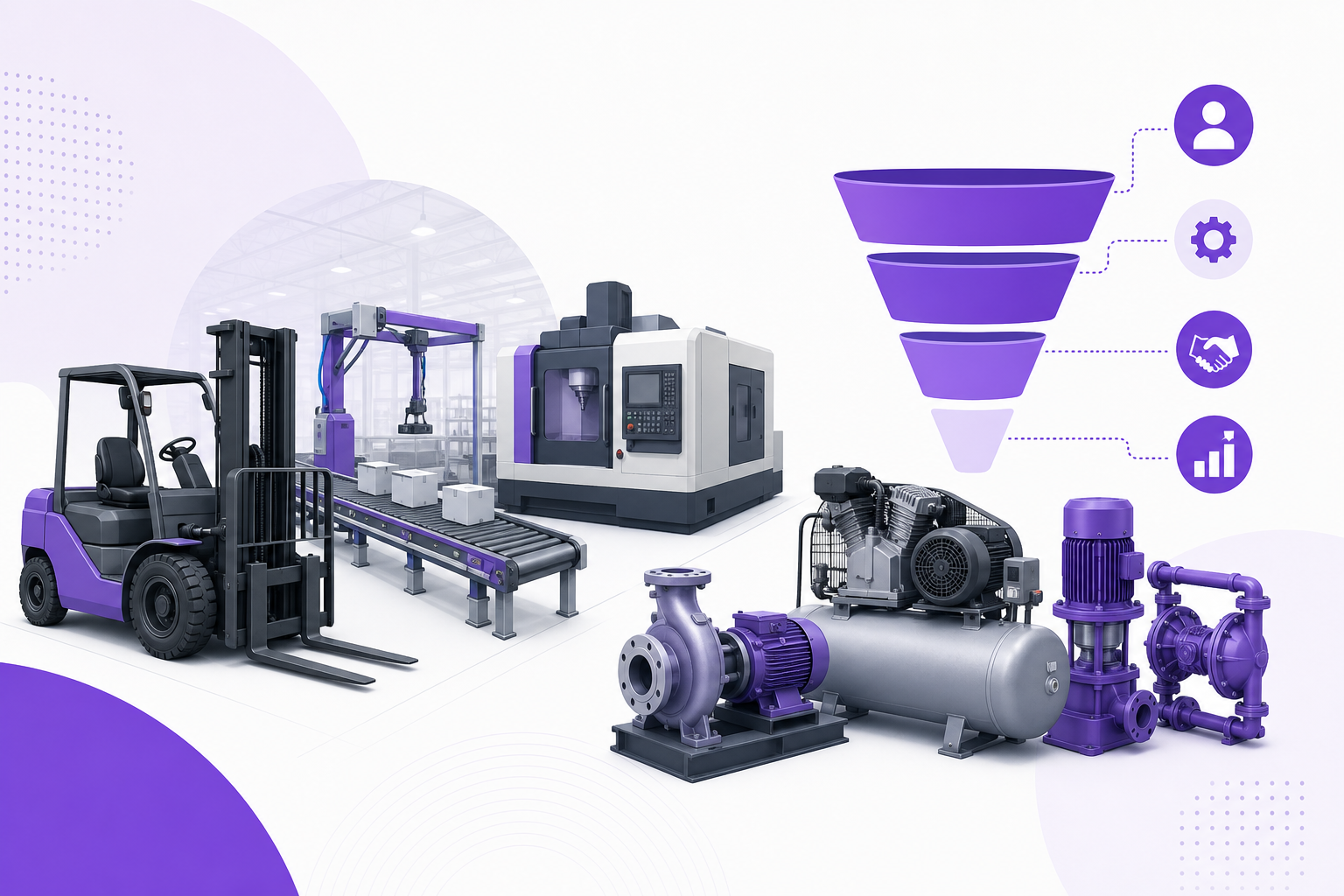
Why Lead Generation Is Challenging for Industrial Equipment Suppliers
Industrial equipment suppliers sell high-value products with long buying cycles.
Your ideal customers may include:
- Manufacturing companies
- Construction firms
- EPC contractors
- Warehousing and logistics companies
- Automotive manufacturers
- Pharmaceutical manufacturers
- Food processing companies
- Chemical manufacturers
- Infrastructure developers
- Government and public sector organizations
The challenge isn't finding businesses—it's identifying companies planning equipment purchases and reaching the people responsible for procurement.
Common Challenges Industrial Equipment Suppliers Face
Many suppliers struggle because they:
- Depend heavily on referrals and repeat customers
- Wait for tender opportunities or inbound inquiries
- Purchase outdated contact databases
- Spend hours researching prospects manually
- Contact generic company email addresses
- Reach the wrong procurement contacts
- Lack a scalable lead generation strategy
As a result, sales teams spend more time searching for buyers than closing deals.
What Makes a High-Quality Industrial Equipment Lead?
A qualified lead contains much more than basic company information. The best B2B leads include:
- Company profile
- Industry
- Equipment requirements
- Company size
- Annual revenue
- Factory or project locations
- Decision-maker names
- Verified business email addresses
- LinkedIn profiles
- Buying relevance
- Ideal Customer Profile (ICP) score
High-quality data helps sales teams focus on companies most likely to purchase.
12 Proven Lead Generation Strategies for Industrial Equipment Suppliers
1. Define Your Ideal Customer Profile (ICP)
Before searching for buyers, clearly define your ideal customer. Your ICP should include:
- Industry
- Equipment category
- Company size
- Geographic location
- Production capacity
- Project size
- Purchase frequency
A well-defined ICP improves targeting and conversion rates. Use our ICP identification guide to build yours.
2. Connect With Decision-Makers
Instead of emailing generic company inboxes, target professionals such as:
- Purchase Manager
- Procurement Manager
- Plant Manager
- Operations Manager
- Engineering Manager
- Maintenance Manager
- Technical Director
- Supply Chain Manager
- Project Manager
- CEO or Founder (for SMEs)
These professionals influence industrial equipment purchasing decisions. Learn more in our decision-maker prospecting guide.
3. Focus on High-Demand Industries
Industrial equipment is required across multiple sectors. Target industries include:
- Manufacturing
- Construction
- Automotive
- Food & Beverage
- Pharmaceuticals
- Chemicals
- Warehousing & Logistics
- Oil & Gas
- Mining
- Renewable Energy
Industry-focused campaigns consistently produce higher-quality leads.
4. Use AI to Discover Qualified Buyers
Rather than manually researching businesses, AI-powered prospecting tools identify companies that closely match your Ideal Customer Profile.
AI filters prospects using:
- Industry
- Equipment relevance
- Company size
- Geographic market
- Business potential
This significantly reduces research time while improving lead quality.
5. Personalize Every Sales Email
Industrial buyers receive countless supplier emails. Stand out by referencing:
- Their industry
- Existing manufacturing operations
- Equipment modernization plans
- Efficiency goals
- How your equipment solves operational challenges
Personalized outreach improves response rates and builds credibility.
6. Segment Your Prospect Lists
Instead of maintaining one large database, organize prospects into focused groups such as:
- Manufacturing companies
- Construction firms
- Pharmaceutical manufacturers
- Food processing companies
- Logistics providers
- EPC contractors
Segmented campaigns consistently outperform generic outreach.
7. Explore Export Opportunities
Industrial equipment suppliers can significantly expand revenue through exports. Potential international markets include:
- United States
- Germany
- United Kingdom
- UAE
- Saudi Arabia
- Canada
- Australia
- Singapore
- South Africa
- Southeast Asia
Global markets offer long-term business opportunities for quality equipment suppliers.
8. Build a Professional Website
Your website should clearly showcase:
- Equipment catalog
- Technical specifications
- Industries served
- Certifications
- Installation services
- Customer success stories
- After-sales support
- Contact information
A strong online presence builds trust before buyers request quotations.
9. Publish Educational Content
Educational content attracts industrial buyers actively researching solutions. Useful topics include:
- Equipment selection guides
- Preventive maintenance
- Energy-efficient machinery
- Automation trends
- Safety standards
- Industrial equipment comparisons
- Cost-saving strategies
- Predictive maintenance
Educational content improves SEO while positioning your company as an industry expert.
10. Build a Structured Follow-Up Process
Industrial equipment purchases usually involve multiple stakeholders and extended evaluations. A strong follow-up process may include:
- Introduction email
- Company profile
- Product catalog
- Technical brochure
- Case study
- Equipment demonstration
- Consultation meeting
Consistent follow-ups significantly improve conversion rates.
11. Track Sales Performance
Measure important KPIs such as:
- Qualified leads generated
- Email response rate
- Meetings booked
- Product demonstrations
- Quotations submitted
- Orders won
- Revenue generated
Performance tracking helps optimize future sales campaigns.
12. Automate Prospect Research
Manual prospecting consumes valuable sales resources. AI-powered automation helps:
- Discover target companies
- Identify procurement decision-makers
- Enrich company information
- Score lead quality
- Match prospects to your ICP
- Prioritize outreach
Automation allows sales teams to focus on customer relationships instead of manual research.
How AI Is Transforming Lead Generation for Industrial Equipment Suppliers
Artificial Intelligence has transformed the way industrial suppliers identify and qualify business opportunities.
Instead of relying only on trade fairs or directories, AI can:
- Find companies matching your Ideal Customer Profile
- Discover verified procurement decision-makers
- Prioritize high-potential buyers
- Analyze company fit
- Enrich business information
- Reduce manual research
This allows sales teams to build stronger pipelines while increasing productivity.
How Adsaga.ai Helps Industrial Equipment Suppliers
Adsaga.ai is an AI-powered B2B lead generation platform designed to help industrial equipment suppliers discover qualified buyers faster.
Instead of creating generic contact lists, Adsaga.ai analyzes your Ideal Customer Profile and identifies companies that closely match your target market.
With Adsaga.ai, industrial equipment suppliers can:
- Find businesses actively purchasing industrial equipment
- Discover verified procurement and engineering decision-makers
- Build highly targeted prospect lists
- Reduce manual research
- Improve outreach quality
- Increase sales productivity
Whether you supply pumps, compressors, conveyors, generators, industrial tools, material handling systems, HVAC equipment, CNC machines, automation systems, or heavy machinery, Adsaga.ai helps your sales team connect with buyers who are most likely to convert into long-term customers.
Frequently Asked Questions
How do industrial equipment suppliers find B2B leads?
Define your ICP, target procurement and engineering decision-makers in manufacturing and construction sectors, use verified prospect data, personalize outreach around equipment needs, and follow up consistently across segmented campaigns.
Who are the best decision-makers to contact?
Purchase Managers, Procurement Managers, Plant Managers, Operations Managers, Engineering Managers, Maintenance Managers, Technical Directors, Supply Chain Managers, Project Managers, and CEOs or Founders at smaller companies.
What is the best lead generation strategy for industrial equipment suppliers?
Combine a clearly defined ICP, verified procurement targeting, personalized messaging by industry, segmented prospect lists, and consistent follow-up across domestic and export markets.
Can AI help industrial equipment suppliers generate better leads?
Yes. AI can identify companies matching your ICP, surface verified procurement and engineering decision-makers, score lead quality, and reduce manual research so your team spends more time building customer relationships.
How can industrial equipment suppliers generate export leads?
Build segmented prospect lists by region, target buyers in markets like the US, Germany, UAE, and Southeast Asia, and personalize outreach around equipment specifications, certifications, and after-sales support.
Final Thoughts
Lead generation for industrial equipment suppliers is no longer about collecting thousands of company names. Success comes from identifying businesses that genuinely need your equipment, connecting with the right procurement decision-makers, and delivering personalized outreach supported by accurate business data.
Suppliers that combine AI-powered prospecting with a clearly defined Ideal Customer Profile consistently generate higher-quality leads, shorten sales cycles, and build a predictable pipeline of B2B customers.
If your sales team spends more time researching prospects than building customer relationships, implementing a smarter lead generation strategy can become one of your biggest competitive advantages. Get started with Adsaga.ai or explore more strategies on the Adsaga blog.