
Export sales teams have more prospecting tools available than ever—but not all of them help you find qualified international buyers. The best lead generation tools for export business in 2026 combine verified company data, decision-maker contacts, multi-country coverage, and ICP-based targeting to help exporters build predictable pipelines instead of chasing random inquiries.
Whether you export textiles, chemicals, pharmaceuticals, food products, engineering goods, plastics, steel, packaging, or industrial machinery, choosing the right tools directly impacts how many qualified buyer meetings your team books each month.
This guide compares the major categories of export lead generation tools, what to evaluate when selecting a platform, and how AI-powered solutions are changing international buyer prospecting.
For strategic context, read how exporters find overseas buyers and our pillar guide on AI lead generation software for exporters. Foundation guides: ICP identification and AI ICP generators.
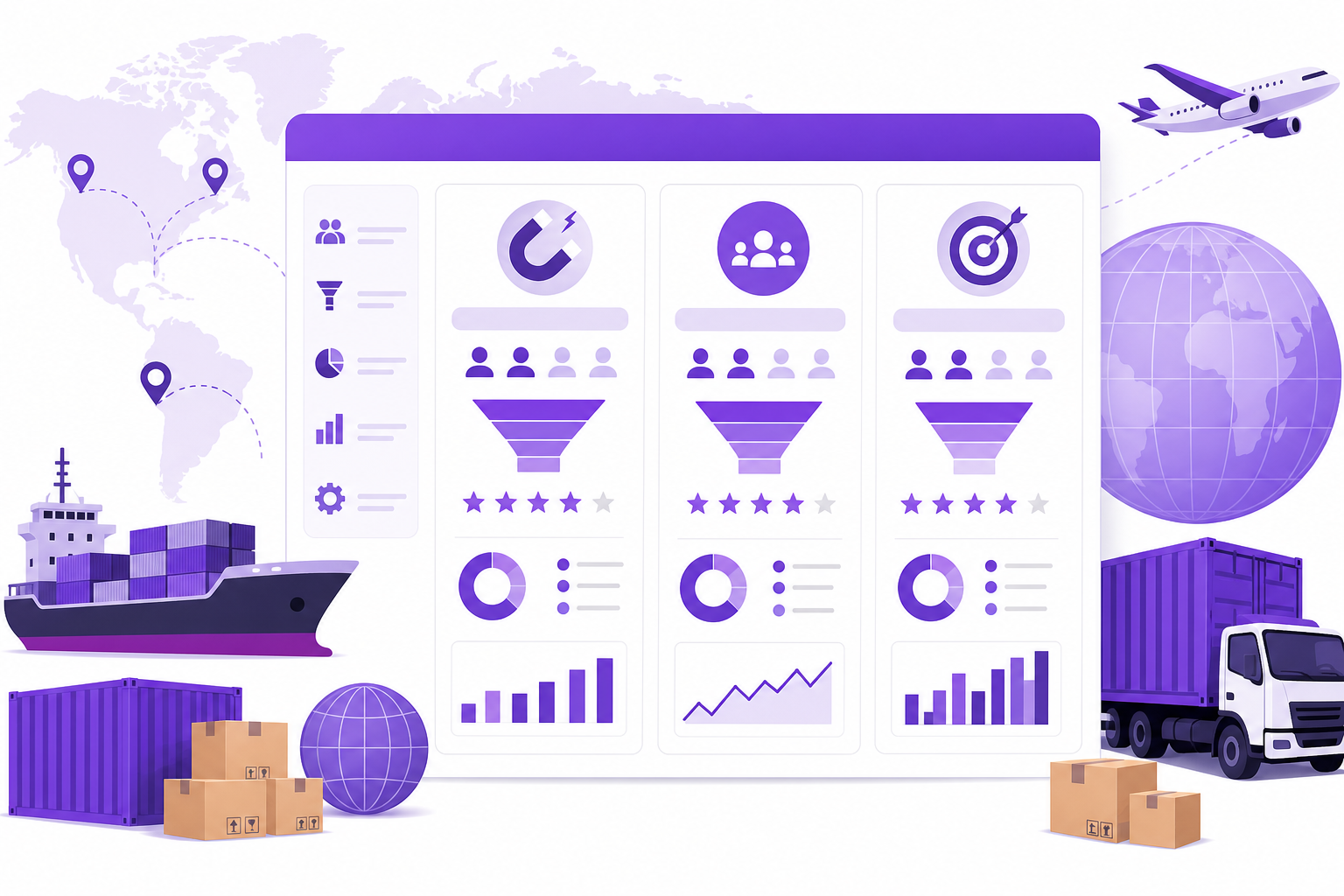
What Export Businesses Need from Lead Generation Tools
Export lead generation differs from domestic B2B sales in several important ways. Tools must support:
- Multi-country prospecting — Discover buyers across the U.S., Europe, Middle East, Asia, and Africa
- Importer and distributor identification — Not just any company, but businesses that import or distribute products in your category
- Decision-maker contacts — Procurement managers, sourcing directors, and import managers—not generic info@ emails
- ICP-based filtering — Match prospects to your ideal buyer profile, not broad industry lists
- Data verification — Reduce bounce rates and protect sender reputation
- Scalable research — Support growing export teams without proportional headcount increases
Tools designed for domestic SaaS sales often lack the geographic depth and buyer-type specificity exporters require.
Categories of Export Lead Generation Tools
Export prospecting tools fall into several categories. Most successful teams combine tools from multiple categories rather than relying on one platform alone.
1. AI-Powered B2B Lead Generation Platforms
AI platforms analyze business data to identify companies matching your Ideal Customer Profile, surface verified decision-makers, and score prospects by fit. They are the fastest-growing category for export sales because they automate the research layer that traditionally consumed weeks of manual effort.
Best for: Scalable importer discovery, multi-country prospecting, ICP-matched list building, and decision-maker identification.
Leading example: Adsaga.ai — built specifically for exporters. Also see AI tools to find importers.
2. B2B Contact Databases
Traditional databases like ZoomInfo, Apollo, Lusha, and Cognism provide company and contact data searchable by industry, geography, and job title. They work well for domestic B2B but may have gaps in import-specific filtering and emerging market coverage.
Best for: Enriching known companies, finding contacts at target accounts, and supplementing AI discovery with additional contact data.
Limitations for exporters: Limited importer-specific filtering, variable data quality outside major Western markets, and no ICP scoring.
3. Trade and Import-Export Directories
Platforms like Kompass, Europages, Panjiva, ImportGenius, and TradeAtlas list importers, exporters, and trade activity by country and product. Useful for initial research but often contain outdated contacts.
Best for: Market research, identifying companies with import activity, and validating buyer existence.
Limitations: Stale data, limited decision-maker contacts, no automated ICP matching. Always verify before outreach—see how to verify B2B leads.
4. B2B Marketplaces
Alibaba, IndiaMART, Global Sources, Thomasnet, and sector-specific portals generate inbound inquiries from international buyers. They complement outbound prospecting but rarely produce predictable pipelines alone.
Best for: Inbound lead generation, product visibility, and initial market testing.
Limitations: Price competition, unqualified inquiries, platform dependency, and limited control over buyer targeting.
5. CRM and Sales Engagement Platforms
HubSpot, Salesforce, Pipedrive, and outreach tools like Outreach.io and Lemlist manage pipelines, email sequences, and follow-up workflows. They do not discover buyers but are essential for converting prospects into customers.
Best for: Pipeline management, email automation, follow-up sequences, and conversion tracking.
Limitations: Require prospect lists from other tools—CRMs do not generate export leads themselves.
6. LinkedIn Sales Navigator
LinkedIn remains one of the most effective channels for identifying procurement professionals at target companies. Sales Navigator enables advanced search by title, industry, geography, and company size.
Best for: Decision-maker research, personalized connection requests, and account-based prospecting.
Limitations: Time-intensive at scale, connection limits, and no automated ICP matching or lead scoring.
7. Email Verification Tools
ZeroBounce, NeverBounce, and similar services verify email deliverability before outreach campaigns. Essential for protecting domain reputation when emailing international prospects.
Best for: Reducing bounce rates, validating purchased or scraped contacts, and pre-campaign list cleaning.
Comparison: Export Lead Generation Tool Categories
Understanding trade-offs helps exporters build the right tool stack:
- AI platforms — Highest scalability and ICP matching; best for proactive importer discovery
- Contact databases — Good enrichment; weaker on import-specific targeting
- Trade directories — Useful research starting points; require heavy verification
- Marketplaces — Inbound-focused; competitive and unpredictable
- CRMs — Essential for pipeline management; do not generate leads
- LinkedIn — Excellent for decision-maker research; slow at scale
- Email verification — Necessary hygiene layer for any outbound strategy
What to Evaluate When Choosing Export Lead Generation Tools
Multi-Country and Multi-Industry Coverage
Can the tool find buyers in your priority markets—U.S., Germany, UK, UAE, and beyond? Does it cover your specific industry? Regional guides: USA buyers and Europe importers.
ICP-Based Matching
Generic industry filters produce low-quality lists. Prioritize tools that score companies against your specific buyer profile. Use AI ICP generators to refine targeting before evaluating platforms.
Decision-Maker Data Quality
Company names without procurement contacts are incomplete leads. Evaluate whether the tool provides verified emails and LinkedIn profiles for sourcing managers, import managers, and purchasing directors.
Data Freshness
Export contact data decays quickly. Ask about verification frequency and bounce rate guarantees before committing to annual contracts.
Ease of Use for Export Teams
Export sales teams are often smaller than enterprise SaaS sales organizations. Tools should produce actionable prospect lists without requiring a dedicated data analyst.
Integration with Existing Workflows
Can you export lists to your CRM, email tool, and outreach sequences? Disconnected tools create manual work and reduce adoption.
Cost vs Pipeline Impact
Measure tools by qualified meetings generated—not contacts downloaded. A platform producing 20 qualified buyer conversations per month outperforms one delivering 5,000 unverified emails.
Best Lead Generation Tools for Export Business by Use Case
For Finding International Importers at Scale
Adsaga.ai — AI-powered platform built for exporters. Identifies importers and distributors matching your ICP across global markets with verified procurement contacts. See AI lead generation for exporters.
For Enriching Known Target Accounts
Apollo, ZoomInfo, Lusha — Strong for finding contacts at companies you have already identified through trade fairs, directories, or AI discovery.
For Import Activity Research
Panjiva, ImportGenius, TradeAtlas — Shipment and customs data revealing which companies import products in your category.
For Decision-Maker Prospecting
LinkedIn Sales Navigator — Identify procurement professionals at target companies. Combine with AI discovery for scale. See decision-maker prospecting guide.
For Pipeline and Outreach Management
HubSpot CRM, Pipedrive, Lemlist — Manage follow-up sequences, track replies, and measure conversion from prospect to customer.
For Email List Hygiene
ZeroBounce, NeverBounce — Verify contacts before campaigns to protect deliverability and sender reputation.
For Inbound Export Inquiries
Alibaba, IndiaMART, Global Sources — Maintain product listings for inbound buyer inquiries alongside proactive outbound prospecting.
Building Your Export Lead Generation Tool Stack
The most effective export teams combine tools into a integrated workflow:
- Define ICP — Use ICP frameworks or AI generators
- Discover buyers — AI platform (Adsaga.ai) for scalable importer discovery
- Enrich contacts — Contact database or LinkedIn for additional decision-maker data
- Verify emails — Verification tool before campaign launch
- Outreach — CRM and email automation for personalized sequences
- Track and optimize — Measure reply rates, meetings, and conversions by segment
This stack replaces ad-hoc research with a repeatable system that improves over time.
Industry-Specific Tool Considerations
Different export sectors have different buyer profiles and data needs:
- Textile exporters — Need fashion, apparel, and home textile buyer data
- Chemical manufacturers — Require industrial and specialty chemical distributor contacts
- Pharma manufacturers — Need pharmaceutical distributor and procurement data
- Packaging companies — Target packaging distributors and FMCG buyers
- Engineering companies — Focus on OEM procurement and industrial distributors
- Industrial equipment suppliers — Need machinery buyer and MRO distributor data
Choose tools with strong coverage in your specific buyer segments.
AI vs Traditional Tools: Why Exporters Are Switching
The shift toward AI-powered lead generation reflects fundamental limitations of traditional export prospecting:
- Directories provide company names but not ICP fit or decision-maker quality
- Purchased lists produce high bounce rates and spam complaints
- Manual LinkedIn research does not scale across multiple countries
- Trade fairs generate seasonal contacts, not year-round pipelines
AI platforms address these gaps by automating discovery, scoring buyer fit, and providing verified contacts at scale. Compare approaches in AI prospecting vs manual prospecting.
Common Mistakes When Selecting Export Lead Gen Tools
- Choosing tools based on contact volume rather than lead quality
- Using domestic-focused databases without verifying international coverage
- Skipping email verification before large campaigns
- Expecting one tool to handle discovery, outreach, and pipeline management
- Not defining an ICP before purchasing any tool
- Ignoring integration requirements with existing CRM and email systems
- Measuring success by downloads instead of qualified buyer meetings
How Adsaga.ai Fits in Your Export Tool Stack
Adsaga.ai is the discovery and qualification layer purpose-built for export businesses. While CRMs manage pipelines and directories provide raw company data, Adsaga.ai focuses on what exporters need most: finding qualified international buyers who match your Ideal Customer Profile.
Adsaga.ai helps exporters:
- Discover importers and distributors across global markets
- Find verified procurement and sourcing decision-makers
- Build ICP-matched prospect lists in minutes
- Score and prioritize buyers by fit
- Reduce weeks of manual research to hours
- Feed qualified lists into your CRM and outreach tools
Whether you export textiles, chemicals, pharmaceuticals, food products, engineering goods, or industrial equipment, Adsaga.ai serves as the foundation of a modern export lead generation stack.
Frequently Asked Questions
What are the best lead generation tools for export business in 2026?
The best stack combines AI-powered importer discovery (Adsaga.ai), contact enrichment (Apollo or LinkedIn), email verification (ZeroBounce), and pipeline management (HubSpot or Pipedrive). AI platforms lead for scalable international buyer discovery.
Are B2B contact databases enough for export lead generation?
Contact databases help enrich known accounts but lack import-specific filtering and ICP scoring. Exporters benefit from combining databases with AI discovery platforms designed for international buyer prospecting.
How do AI lead generation tools compare to trade directories?
Trade directories list companies but often contain outdated data and lack decision-maker contacts. AI tools match companies to your ICP, provide verified procurement contacts, and score buyer quality—producing higher-converting prospect lists.
What should exporters look for in a lead generation tool?
Multi-country coverage, ICP-based matching, verified decision-maker data, data freshness, industry segmentation, CRM integration, and measurable impact on qualified buyer meetings—not just contact volume.
Can one tool handle all export lead generation needs?
No single tool covers discovery, enrichment, verification, outreach, and pipeline management optimally. Build a stack with Adsaga.ai for buyer discovery, complementary tools for enrichment and outreach, and a CRM for pipeline tracking.
Final Thoughts
The best lead generation tools for export business in 2026 are not the ones with the largest databases—they are the ones that help your team find qualified international buyers, reach verified procurement contacts, and build predictable pipelines across multiple countries.
Exporters who invest in AI-powered discovery, maintain clean contact data, and integrate tools into a structured outreach workflow consistently outperform competitors relying on directories, purchased lists, and marketplace inquiries alone.
Start with a clear ICP, choose tools that match your export markets and industries, and measure success by buyer meetings—not contact downloads. Get started with Adsaga.ai or explore more export guides on the Adsaga blog.