
Export prospecting is the systematic process of identifying, qualifying, and engaging international buyers who match your products and target markets — and it's the foundation every successful export business builds before the first shipment leaves the port.
Without structured prospecting, export sales depends on luck: a trade fair contact here, a marketplace inquiry there. With it, your team generates a predictable pipeline of qualified buyers across multiple countries — week after week, quarter after quarter.
This step-by-step export prospecting guide walks you through the complete workflow for 2026 — from defining your Ideal Customer Profile and selecting target markets to finding buyers, reaching decision-makers, running outreach campaigns, and converting prospects into long-term export customers.
Related export resources: how exporters find overseas buyers, export lead generation strategies, and AI lead generation software for exporters. For B2B fundamentals, start with B2B lead generation, ICP-based lead generation, and B2B sales prospecting.
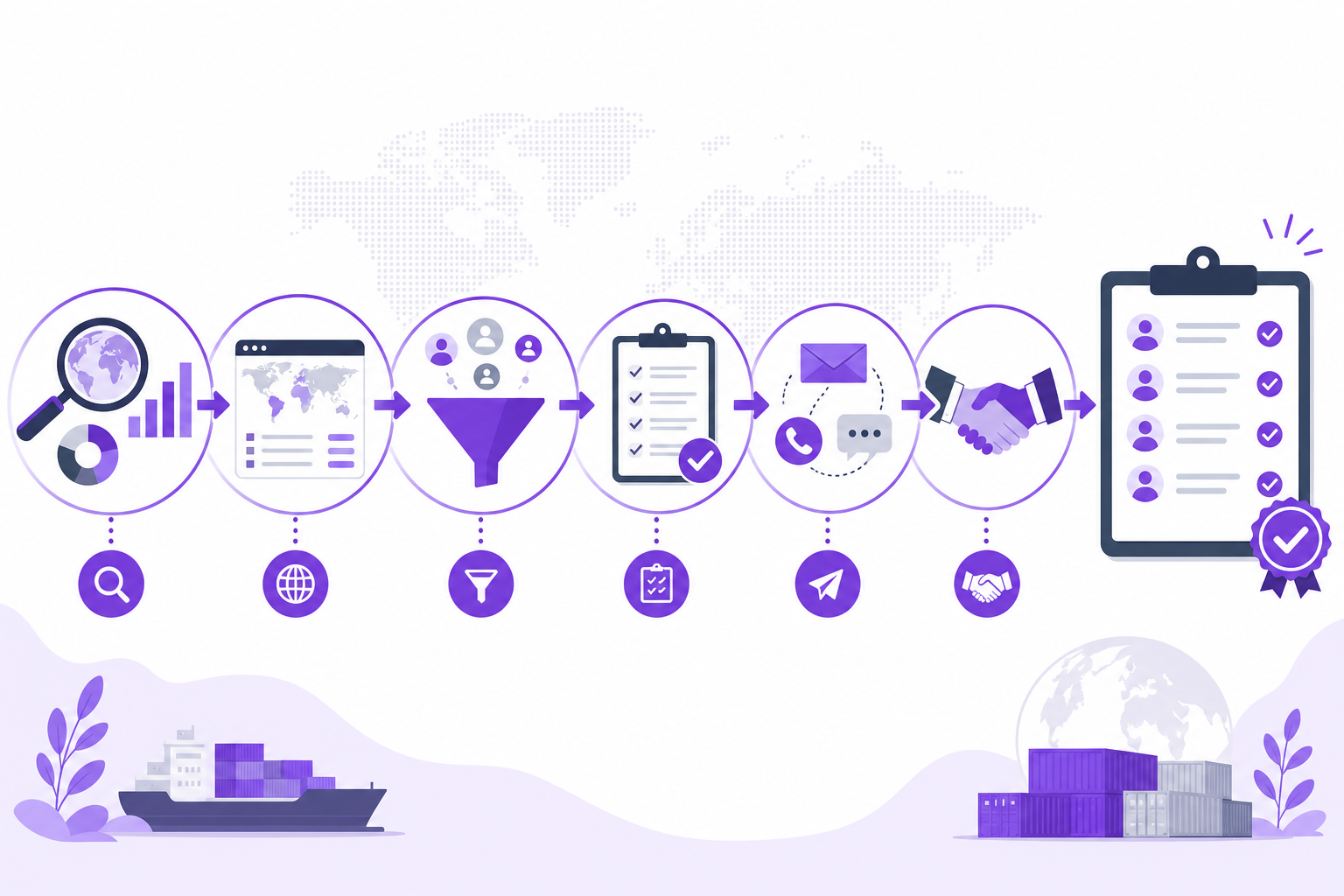
What Is Export Prospecting?
Export prospecting is the proactive search for international B2B buyers who are likely to purchase your products for import, distribution, or resale. It differs from inbound marketing (waiting for buyers to find you) and reactive sales (responding only to inquiries).
Effective export prospecting includes:
- Identifying companies that import or distribute your product category
- Qualifying prospects against your Ideal Customer Profile
- Finding and verifying decision-maker contacts
- Initiating personalized outreach across email, LinkedIn, and phone
- Following up systematically until engagement or disqualification
- Moving engaged prospects through your sales pipeline to close
Prospecting is not a one-time activity — it's a continuous engine that feeds your export pipeline year-round.
Why Export Prospecting Matters More in 2026
Several trends make structured prospecting essential for exporters:
- Rising competition: More exporters from emerging markets compete for the same international buyers
- Buyer sophistication: Importers evaluate multiple suppliers digitally before responding to outreach
- Data availability: AI and trade data make proactive prospecting more effective than ever
- Trade show decline: Virtual and hybrid events reduce serendipitous buyer encounters
- Margin pressure: Exporters can't afford long sales cycles with unqualified prospects
Exporters who prospect systematically outperform those relying on referrals and trade fairs alone. The data is clear: proactive prospecting generates 3–5x more qualified pipeline than passive inbound channels.
Step 1: Define Your Export Ideal Customer Profile
Every prospecting workflow starts with a clear ICP. Without it, your team contacts companies that will never buy.
ICP Components for Export Prospecting
- Product fit: Categories, specifications, certifications required
- Buyer type: Importer, distributor, wholesaler, OEM, government
- Geography: Target countries and regions
- Company size: Revenue range, employees, warehouse capacity
- Import behavior: Volume, frequency, current sourcing countries
- Decision-maker titles: Procurement manager, sourcing director, import manager
- Disqualifiers: Company size too small, wrong product category, domestic-only operations
Use our ICP identification guide and AI ICP generator to build your profile. Read ICP-based lead generation to understand why targeted lists outperform bulk databases.
Step 2: Select and Prioritize Target Markets
Don't prospect everywhere at once. Prioritize 2–3 markets based on:
- Import demand: Growing import volumes for your HS code category
- Competitive gap: Room for a new supplier vs. saturated markets
- Regulatory fit: Your certifications meet local requirements
- Logistics feasibility: Competitive shipping costs and delivery times
- Payment security: Acceptable payment terms and low default risk
- Existing traction: Inbound inquiries or successful shipments already
Build market density — deep prospecting in fewer markets — before expanding broadly. A pipeline of 200 qualified prospects in Germany outperforms 50 prospects each across 10 countries.
Step 3: Build Your Prospecting Source Stack
Combine multiple data sources for comprehensive buyer discovery:
AI-Powered Buyer Discovery
AI lead generation software and AI tools to find importers scan company databases across countries, filter by ICP criteria, and surface decision-maker contacts. This is your highest-volume, most scalable source.
Customs and Trade Import Data
Import records reveal which companies actually bring your product category into a country — the strongest buying signal available. Cross-reference trade data with company enrichment for contact details.
LinkedIn Sales Navigator
Search decision-makers by title, company, industry, and geography. LinkedIn complements AI discovery with real-time profile data and engagement opportunities.
Industry Directories and Trade Associations
Sector-specific directories list established importers and distributors. Use as a supplement to AI — always verify contacts before outreach.
Trade Show Attendee Lists
Pre-show prospecting using exhibitor and attendee directories. Schedule meetings before the event to maximize ROI.
Customer and Partner Referrals
Ask existing international customers for introductions to buyers in adjacent markets or product categories.
Step 4: Generate and Verify Your Prospect List
With sources configured, build your initial prospect list:
- Run AI prospecting filtered by ICP criteria in priority markets
- Supplement with trade data import records for your HS code
- Cross-reference LinkedIn for decision-maker validation
- Deduplicate across sources — one record per company
- Verify email addresses and phone numbers before outreach
- Score each prospect by ICP fit (high, medium, low)
- Segment lists by buyer type, market, and score tier
Never outreach unverified contacts. Bounced emails damage sender reputation and waste follow-up effort. Read how to verify B2B leads before outreach and lead verification best practices.
Step 5: Identify Decision-Makers
Reaching the right person determines whether your outreach gets a response or lands in a generic inbox.
Key Decision-Maker Titles for Export Prospecting
- Procurement Manager / Director
- Purchasing Manager / Director
- Sourcing Manager / Director
- Import Manager
- Category Manager / Buyer
- Supply Chain Director
- Business Development Director (for distributors)
- CEO / Founder (for SMEs)
AI tools identify these contacts automatically. For manual research, use LinkedIn and company websites. Our decision-maker guide and how AI finds decision-makers cover advanced techniques.
Step 6: Craft Export-Specific Outreach Messages
Export outreach must communicate value quickly — international buyers evaluate dozens of supplier pitches weekly.
Email Structure That Works
- Subject line: Specific to their product category or market — not generic
- Opening: Reference their business, import activity, or market position
- Value proposition: What your product offers — quality, price, certification, reliability
- Social proof: Existing markets, customer references, shipment volumes
- Call to action: Clear next step — catalog, sample, discovery call
- Signature: Name, title, company, direct contact, website
Personalization Elements
- Reference their current product portfolio or import categories
- Mention relevant certifications (ISO, CE, FDA, organic, halal)
- Cite market-specific demand trends or opportunities
- Include a case study from a similar buyer in their region
Avoid "Dear Sir/Madam" and "We are a leading manufacturer." Specificity wins in export outreach.
Step 7: Run Multi-Touch Follow-Up Sequences
Single emails rarely convert in export sales. Run structured sequences:
- Touch 1 (Day 1): Personalized introduction email
- Touch 2 (Day 3): LinkedIn connection request with context
- Touch 3 (Day 7): Follow-up email with product catalog or certification
- Touch 4 (Day 14): LinkedIn message referencing previous outreach
- Touch 5 (Day 21): Value-add email — market insight, case study, or industry report
- Touch 6 (Day 28): Phone call or final email with direct question
- Touch 7 (Day 35): Break-up email — "Should I close your file?"
Track every touchpoint in your CRM. Prospects who don't respond to one channel may respond to another. See AI workflow for sales teams for automation options.
Step 8: Qualify Engaged Prospects
When a prospect responds, qualify before investing in samples, custom pricing, or compliance documentation:
BANT Framework for Export Sales
- Budget: Can they afford your pricing at required volumes?
- Authority: Is the contact a decision-maker or influencer?
- Need: Do they actively source your product category?
- Timeline: When do they plan to place an order?
Export-Specific Qualification Questions
- What volumes do you typically import per shipment?
- Which countries do you currently source from?
- What certifications do you require from suppliers?
- What are your standard payment terms?
- Do you handle customs clearance or need DDP terms?
- Are you evaluating multiple suppliers or ready to proceed?
Disqualify early when prospects don't match your ICP. Protecting sales time is as important as finding new prospects. Learn how AI qualifies leads for automated scoring.
Step 9: Move Prospects Through Your Export Pipeline
Define clear pipeline stages and conversion criteria:
- Identified: Company matches ICP, added to prospect list
- Contacted: Initial outreach sent, awaiting response
- Engaged: Prospect replied, discovery conversation scheduled
- Qualified: BANT confirmed, moving toward commercial discussion
- Quoted: Pricing, terms, and specifications shared
- Sample/Trial: Product sample sent or trial shipment arranged
- Negotiating: Terms, pricing, and contract under discussion
- Won: First order confirmed
- Lost: Disqualified or chose competitor — document reason
Review pipeline weekly. Stalled deals need re-engagement or disqualification. See building a predictable B2B sales pipeline.
Step 10: Optimize and Scale Your Prospecting
After your first prospecting cycle, analyze and improve:
Metrics to Review Monthly
- Prospects added per week by source and market
- Outreach response rate by message variant and channel
- Meeting conversion rate from responses
- Quote-to-close ratio by buyer segment
- Average deal cycle length by market
- Pipeline value and weighted forecast
Optimization Actions
- Double down on markets and segments with highest response rates
- Refine email subject lines and opening hooks based on A/B test data
- Adjust ICP criteria if too many prospects disqualify late
- Increase prospecting volume in winning markets
- Retire underperforming channels and reallocate effort
Document winning playbooks so new team members replicate success quickly. Read export lead generation strategies for channel-specific tactics.
Export Prospecting by Buyer Type
Prospecting for Importers
Target companies with active import records in your HS code. Emphasize product quality, competitive pricing, and supply reliability. Importers often evaluate multiple suppliers — speed and professionalism matter.
Prospecting for Distributors
Focus on companies with existing distribution networks in your category. Propose territory coverage, margin structures, and marketing support. See finding distributors worldwide.
Prospecting for Wholesale Buyers
Target bulk purchasers with volume pricing needs. Lead with MOQ tiers, lead times, and references from similar wholesale accounts. See finding wholesale buyers.
Prospecting for OEM and Manufacturing Buyers
Identify manufacturers sourcing components or raw materials. Emphasize technical specifications, quality consistency, and supply chain reliability. Longer sales cycles require sustained nurturing.
Export Prospecting by Industry
Tailor your prospecting approach to industry-specific buying patterns:
- Textile exporters — seasonal cycles, fashion trade events, fabric sourcing managers
- Chemical exporters — technical buyers, compliance documentation, REACH requirements
- Pharmaceutical manufacturers — regulatory approvals, GMP certification, tender processes
- Packaging companies — FMCG supply chains, sustainability mandates
- Industrial equipment — project-based procurement, technical demonstrations
- Steel manufacturers — construction pipelines, infrastructure projects
- Machinery exporters — capital equipment cycles, service network requirements
Common Export Prospecting Mistakes
- No ICP definition — contacting anyone with a company name
- Spreading too thin — prospecting 15 countries with 20 contacts each
- Unverified data — high bounce rates from stale directories
- Generic outreach — template emails with no personalization
- Single touch and quit — giving up after one unanswered email
- No CRM tracking — losing track of follow-ups and pipeline stages
- Ignoring disqualification — pursuing prospects who will never buy
- Manual-only prospecting — not leveraging AI and trade data tools
Avoid these pitfalls and your prospecting efficiency improves immediately. See top B2B lead generation mistakes for more.
Your First 30 Days: Export Prospecting Quick Start
Ready to start? Follow this 30-day plan:
Week 1: Foundation
- Define export ICP with buyer type, geography, and decision-maker titles
- Select 2 priority markets based on import demand analysis
- Set up CRM with pipeline stages from Step 9
- Configure AI prospecting tool with ICP filters
Week 2: List Building
- Generate 200+ prospects per priority market using AI and trade data
- Verify all email contacts
- Score and segment by ICP fit (high/medium/low)
- Identify decision-makers for top 100 high-fit accounts
Week 3: Outreach Launch
- Write 3 email templates segmented by buyer type
- Launch Touch 1 to top 50 high-fit prospects per market
- Send LinkedIn connection requests to matched decision-makers
- Track all activity in CRM
Week 4: Follow-Up and Review
- Execute Touches 2–3 for Week 3 prospects
- Launch Touch 1 for next 50 prospects per market
- Review response rates and refine messaging
- Book discovery calls with engaged prospects
- Plan Month 2 expansion based on early results
This quick start creates momentum and generates data to optimize your ongoing prospecting engine.
Frequently Asked Questions
What is export prospecting?
Export prospecting is the systematic process of identifying international B2B buyers matching your ICP, qualifying them, finding decision-maker contacts, initiating personalized outreach, and moving engaged prospects through your sales pipeline to close.
How do I find international buyers for my export products?
Use AI-powered buyer discovery, customs import data, LinkedIn prospecting, trade show attendee lists, B2B marketplaces, and customer referrals. Define your ICP first, then build verified prospect lists in 2–3 priority markets.
How many follow-ups should export prospecting include?
Run 5–8 touches over 3–5 weeks across email, LinkedIn, and phone. International buyers rarely respond to a single email. Structured multi-channel sequences achieve 3–5x higher engagement than single-touch outreach.
Can small export teams prospect effectively without a large budget?
Yes. AI prospecting tools give small teams access to the same buyer intelligence as large export departments. Focus on 2–3 markets, build dense prospect lists, and run consistent outreach — quality targeting beats mass volume.
How long until export prospecting produces results?
Initial engagement typically occurs within 4–8 weeks. First orders usually take 3–6 months depending on product complexity and buyer approval processes. A structured 30-day quick start accelerates early pipeline momentum.
Final Thoughts
Export prospecting is the engine behind every successful international sales operation. Without it, revenue depends on chance. With it, your team builds a predictable pipeline of qualified buyers across multiple markets.
Follow the ten-step workflow: define your ICP, select markets, build your source stack, verify prospects, identify decision-makers, craft personalized outreach, run multi-touch sequences, qualify engaged leads, manage your pipeline, and optimize continuously.
Start with two priority markets, 200 verified prospects, and a 30-day quick start plan. The exporters who prospect systematically today will own the international markets of tomorrow. Explore AI for export sales and more guides on the Adsaga blog.
How Adsaga.ai Powers Export Prospecting
Adsaga.ai is the AI-powered prospecting platform export teams use to find, qualify, and engage international buyers — replacing weeks of manual research with hours of targeted discovery.
Built specifically for B2B export sales, Adsaga.ai analyzes your Ideal Customer Profile and surfaces companies matching your products, industries, and target markets.
Export teams using Adsaga.ai for prospecting can:
- Discover international buyers, importers, distributors, and wholesalers
- Find verified procurement and sourcing decision-makers
- Build segmented prospect lists by country, industry, and buyer type
- Score every prospect by AI-powered ICP fit
- Reduce manual research time by 40–60%
- Run prospecting across multiple markets simultaneously
- Feed qualified leads directly into outreach campaigns
From your first prospect list to a full international pipeline, Adsaga.ai gives export sales teams the intelligence to prospect smarter and close faster. Get started with Adsaga.ai and build your export prospecting engine today.